
The Madaxeman
Madaxeman.com's Home Page
  • Home
  • Latest Posts
  • Links Page
  • Battle Reports
  • ADLG Index
  • ADLG Wiki
  • Malifaux
  • C London Club
  • 15mm Gallery
  • 15mm Suppliers
  • Facebook
  • The Podcast
  • 10mm
  • Consent Preferences
 RSS Feed

Madaxemans 10mm & Real World Photo Gallery

Photos from museums, and from my 10mm wargaming collection

  • Home
  • Login
  • Album list
    • Last uploads
    • Last comments
    • Most viewed
    • Top rated
    • By date
    • My Favorites
  • Search

The 10mm & Real World Museums Photo Directory - helping you choose the best 10mm tanks, or dig out real cammo schemes from tanks and other military vehicles in museums and shows around the world. You can also search the directory by manufacturer, army or keyword

Anyone can rate the photos just by clicking on the stars beneath each photo. Ratings use a scale of 0-5 where 5 = excellent and 0 = terrible.

Home > Museums and Shows > Bovington

Last additions - Bovington
PICT1767.JPG
Lee/Grant110 viewsThe M3 was well armed and armored for the period, but due to design flaws (high silhouette, archaic sponson mounting of the main gun, below-average off-road performance) it was not satisfactory and was withdrawn from front line duty as soon as the M4 Sherman became available in large numbers.May 19, 2013
PICT1766.JPG
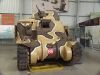
Lee/Grant114 viewsBritish Lees and Grants were in action against Rommel's forces at the disastrous Battle of Gazala on 27 May that year. They continued to serve in North Africa until the end of that campaign. A regiment of M3 Mediums was also used by the U.S. 1st Armored Division in North Africa. In the North African campaign, the M3 was generally appreciated for its mechanical reliability, good armor and heavy firepower.May 19, 2013
PICT1764.JPG
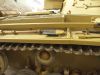
The Tiger I111 viewsThis is the colour to paint hose spades on your 15mm models..May 19, 2013
PICT1763.JPG
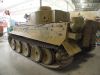
The Tiger I111 views Generally speaking, it took about twice as long to build a Tiger I as another German tank of the period. When the improved Tiger II began production in January 1944, the Tiger I was soon phased out.May 19, 2013
PICT1762.JPG
Matilda II117 viewsThe tank's suspension system was that which had been developed by Vickers for their Medium C prototype in the mid-1920s.[22] The tank was carried by five double wheel bogies on each side. Four of the bogies were on bellcranks in pairs with a common horizontal coil spring. The fifth, rearmost, bogie was sprung against a hull bracket. Between the first bogie and the idler wheel was a larger diameter vertically sprung "jockey wheel"May 19, 2013
PICT1759.JPG
The Tiger I159 viewsProduction of the Tiger I began in August 1942, and 1,355 were built by August 1944 when production ceased. Production started at a rate of 25 per month and peaked in April 1944 at 104 per month. Strength peaked at 671 on 1 July 1944May 19, 2013
PICT1760.JPG
The Tiger I116 viewsMany modifications were introduced during the production run to improve automotive performance, firepower and protection. Simplification of the design was implemented, along with adjustments for shortages. In 1942 alone, at least six revisions were made, starting with the removal of the Vorpanzer (frontal armour shield) from the pre-production models in April. In May, mudguards bolted onto the side of the pre-production run were added, while removable mudguards saw full incorporation in September.May 19, 2013
PICT1761.JPG
The Tiger I117 viewsFrom a 30 degree angle the Tiger's 88mm gun was capable of penetrating the front glacis plate of an American M4 Sherman between 1,800 and 2,100 m (1.1 and 1.3 mi), the British Churchill IV between 1,100 and 1,700 m (0.68 and 1.1 mi), the Soviet T-34 between 800 and 1,400 m (0.50 and 0.87 mi), and the Soviet IS-2 between 100 and 300 m (0.062 and 0.19 mi)May 19, 2013
PICT1757.JPG
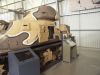
Matilda II110 viewsWhile the Matilda possessed a degree of protection that was then unmatched in the North African theatre, the sheer weight of the armour mounted on the vehicle contributed to a very low average speed of about 6 mph (9.7 km/h) on desert terrain. At the time, this was not thought to be a problem since British infantry tank doctrine prioritized heavy armour and trench-crossing ability over speed and cross-country mobility (which was considered to be characteristic of cruiser tanks such as the Crusader)May 19, 2013
PICT1758.JPG
The Tiger I114 viewsAlthough the general design and layout were broadly similar to the previous medium tank, the Panzer IV, the Tiger weighed more than twice as much. This was due to its substantially thicker armour, the larger main gun, greater volume of fuel and ammunition storage, larger engine, and more solidly-built transmission and suspension.May 19, 2013
270 files on 27 page(s) 1 - 5 6 7 8 9 10 11 12 13 14 - 27


Visit Madaxeman on

Youtube Logo
Blogger Logo
Facebook Logo
Podbean Logo
Twitter Logo
Spotify Logo
Pinterest Logo
iTunes Logo
Tune In Logo

Podcasts to download from Madaxeman.com

(Also available on Podbean, iTunes and Spotify)


(These are "affiliate links". If you buy something after clicking on them I get a small kickback from eBay)

Page Loads for the 10mm & Museums Gallery:

About This Site & Privacy Information

Powered by Coppermine Photo Gallery