
The Madaxeman
Madaxeman.com's Home Page
  • Home
  • Latest Posts
  • Links Page
  • Battle Reports
  • ADLG Index
  • ADLG Wiki
  • Malifaux
  • C London Club
  • 15mm Gallery
  • 15mm Suppliers
  • Facebook
  • The Podcast
  • 10mm
  • Consent Preferences
 RSS Feed

Madaxemans 10mm & Real World Photo Gallery

Photos from museums, and from my 10mm wargaming collection

  • Home
  • Login
  • Album list
    • Last uploads
    • Last comments
    • Most viewed
    • Top rated
    • By date
    • My Favorites
  • Search

The 10mm & Real World Museums Photo Directory - helping you choose the best 10mm tanks, or dig out real cammo schemes from tanks and other military vehicles in museums and shows around the world. You can also search the directory by manufacturer, army or keyword

Anyone can rate the photos just by clicking on the stars beneath each photo. Ratings use a scale of 0-5 where 5 = excellent and 0 = terrible.

Home > Museums and Shows > Bovington

Most viewed - Bovington
IMGP0593.JPG
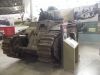
SOMUA S35 136 viewsDuring the German invasion of May 1940, the SOMUA S35 proved itself to be a tactically effective type, but this was negated by strategic mistakes in deploying its units. After the defeat of France in June 1940, limiting production to a number of 430, captured SOMUA S35s were used by the Axis powers. A derived type, the SOMUA S40, with an improved suspension, lowered hull cast and welded turret armour, had been planned to replace the original version on the production lines in July 1940.
IMGP0608.JPG
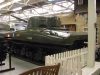
Sherman136 viewsThe Sherman would finally give way to post-war tanks developed from the M26. Various original and updated versions of the Sherman would continue to see combat effectively in many later conflicts, including the Korean War, Arab-Israeli Wars, and Indo-Pakistani War (where it was used by both sides) into the late 20th century
PICT1707.JPG
Little Willie135 viewsLittle Willie was a prototype in the development of the British Mark I tank. Constructed in the autumn of 1915 at the behest of the Landships Committee, it was the first completed tank prototype in history. Little Willie is the oldest surviving individual tank, preserved as one of the most famous pieces in the collection of the British Bovington Tank Museum.
IMGP0563.JPG
Type 95 Japanese tank134 viewsThe Type 95 was a 7.4-tonne vehicle with a complement of 3 crewmen: a commander, a hull machine gunner, and a driver. Only the commander was seated in the turret, hence he was responsible for observation, loading, aiming, firing the main gun, as well as decision-making and commanding the crew. The hand-operated turret was small and extremely cramped.
IMGP0571.JPG
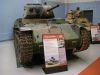
T-26134 viewsThe T-26 tank was a Soviet light infantry tank used during many conflicts of the 1930s as well as during World War II. It was a development of the British Vickers 6-Ton tank and is widely considered one of the most successful tank designs of the 1930s
IMGP0601.JPG
Sherman134 viewsWhen the Sherman tank arrived in North Africa in 1942, it was clearly superior to both the Panzer III German main battle tank and the short barreled version of the Panzer IV. Against the 75mm KwK 40 L/43 long barreled Panzer IV the match was about even. For this reason, the US Army believed the Sherman would be completely adequate to win the war, and no pressure was exerted for further tank development
PICT1704.JPG
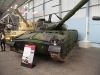
Challenger 134 viewsThe British FV4030/4 Challenger 1, was the main battle tank (MBT) of the British Army from 1983 to the mid-1990s, when it was superseded by the Challenger 2. It is also currently used by the Jordanian Armed Forces as their main battle tank after heavy modifications. The variants for the Jordanian military are upgraded using an unmanned turret called the Falcon Turret.
PICT1840.JPG
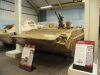
Haggalunds AFV134 views
IMGP0568.JPG
Pz II Luchs133 viewsA light reconnaissance tank, the Ausf. L was the only Panzer II design with the overlapping/interleaved road wheels and "slack track" configuration to enter series production, with 100 being built from September 1943 to January 1944 in addition to conversion of the four Ausf. M tanks. Originally given the experimental designation VK 1303, it was adopted under the alternate name Panzerspähwagen II and given the popular name Luchs (Lynx).
IMGP0612.JPG
Shooting a PIAT133 viewsThe Projector, Infantry, Anti Tank (PIAT) was a British hand-held anti-tank weapon developed during the Second World War. The PIAT was designed in 1942 in response to the British Army's need for a more effective infantry anti-tank weapon, and entered service in 1943.
The PIAT was based on the spigot mortar system, that launched a 2.5 pounds (1.1 kg) bomb using a powerful spring and a cartridge on the tail of the projectile
270 files on 27 page(s) 1 - 5 6 7 8 9 10 11 12 13 14 - 27


Visit Madaxeman on

Youtube Logo
Blogger Logo
Facebook Logo
Podbean Logo
Twitter Logo
Spotify Logo
Pinterest Logo
iTunes Logo
Tune In Logo

Podcasts to download from Madaxeman.com

(Also available on Podbean, iTunes and Spotify)


(These are "affiliate links". If you buy something after clicking on them I get a small kickback from eBay)

Page Loads for the 10mm & Museums Gallery:

About This Site & Privacy Information

Powered by Coppermine Photo Gallery