
The Madaxeman
Madaxeman.com's Home Page
  • Home
  • Latest Posts
  • Links Page
  • Battle Reports
  • ADLG Index
  • ADLG Wiki
  • Malifaux
  • C London Club
  • 15mm Gallery
  • 15mm Suppliers
  • Facebook
  • The Podcast
  • 10mm
  • Consent Preferences
 RSS Feed

Madaxemans 10mm & Real World Photo Gallery

Photos from museums, and from my 10mm wargaming collection

  • Home
  • Login
  • Album list
    • Last uploads
    • Last comments
    • Most viewed
    • Top rated
    • By date
    • My Favorites
  • Search

The 10mm & Real World Museums Photo Directory - helping you choose the best 10mm tanks, or dig out real cammo schemes from tanks and other military vehicles in museums and shows around the world. You can also search the directory by manufacturer, army or keyword

Anyone can rate the photos just by clicking on the stars beneath each photo. Ratings use a scale of 0-5 where 5 = excellent and 0 = terrible.

Home > Museums and Shows > Bovington

Most viewed - Bovington
IMGP0606.JPG
Matilda II CDL153 viewsMatilda II CDL / Matilda V CDL (Canal Defence Light)
The normal turret was replaced by a cylindrical one containing a searchlight (projected through a vertical slit) and a BESA machine gun.
PICT1710.JPG
Medium Mark A Whippet153 viewsThe Medium Mark A Whippet was a British tank of World War I. It was intended to complement the slower British heavy tanks by using its relative mobility and speed in exploiting any break in the enemy lines. Possibly the most successful British tank of World War I, the Whippet was responsible for more German casualties than any other British tank of the war. Whippets later took part in several of the British Army's postwar actions, notably in Ireland and North Russia.
IMGP0580.JPG
M10 Tank Destroyer152 viewsThe M10 tank destroyer, formally 3-inch Gun Motor Carriage, M10 was a United States tank destroyer of World War II based on the chassis of the M4 Sherman tank. It was numerically the most important U.S. tank destroyer of World War II and combined a reasonably potent anti-tank weapon with a turreted platform (unlike the previous M3 GMC, whose gun was capable of only limited traverse). Despite the introduction of more-powerful types as replacements, it remained in service until the end of the war. Some of those replacements were in fact modified and/or rebuilt from the M10 itself.
IMGP0590.JPG
Tiger II152 viewsThe Tiger II was developed late in the war and built in relatively small numbers - 1,500 Tiger IIs were ordered, but production was severely disrupted by Allied bombing. Among others, five raids between 22 September and 7 October 1944 destroyed 95 percent of the floor area of the Henschel plant. It is estimated that this caused the loss in production of some 657 Tiger IIs. Only 492 units were produced: one in 1943, 379 in 1944, and 112 in 1945. Full production ran from mid-1944 to the end of the war
IMGP0620.JPG
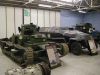
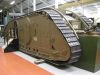
WW1 British tanks152 views The environment inside was extremely unpleasant; since ventilation was inadequate, the atmosphere was contaminated with poisonous carbon monoxide, fuel and oil vapours from the engine, and cordite fumes from the weapons.
PICT1747.JPG
The Tiger I152 viewsThe Tiger I had frontal hull armour 100 mm (3.9 in) thick and frontal turret armour of 120 mm (4.7 in), as opposed to the 80 mm (3.1 in) frontal hull and 50 mm (2 in) frontal turret armour of contemporary models of the Panzer IV
PICT1748.JPG
The Tiger I152 viewsThe Tiger differed from earlier German tanks principally in its design philosophy. Its predecessors balanced mobility, armour and firepower, and were sometimes outgunned by their opponents.
The Tiger I represented a new approach that emphasised firepower and armour. While heavy, this tank was not slower than the best of its opponents.
PICT1772.JPG
T34/85152 viewsThe T-34 was a Soviet medium tank produced from 1940 to 1958. When it first appeared on the battlefield in 1941, German tank generals von Kleist and Guderian called it "the deadliest tank in the world."
PICT1841.JPG
Sv 203 S Tank152 viewsThe Strv 103 was developed in the 1950s and was the first main battle tank to use a turbine engine. The result was a very low-profile design with an emphasis on defense and heightened crew protection level. Strv 103s formed a major portion of the Swedish armoured forces from the 1960s to part of the 1990s, but have since been removed from service in favour of the Stridsvagn 122.
IMGP0609.JPG
King Tiger151 viewsLike the Tiger I, each tank was issued with two sets of tracks: a normal "battle track" and a narrower "transport" version used during rail movement. The transport tracks reduced the overall width of the load and could be used to drive the tank short distances on firm ground. The crew were expected to change to normal battle tracks as soon as the tank was unloaded
270 files on 27 page(s) 1 - 9 10 11 12 13 14 15 16 17 18 - 27


Visit Madaxeman on

Youtube Logo
Blogger Logo
Facebook Logo
Podbean Logo
Twitter Logo
Spotify Logo
Pinterest Logo
iTunes Logo
Tune In Logo

Podcasts to download from Madaxeman.com

(Also available on Podbean, iTunes and Spotify)


(These are "affiliate links". If you buy something after clicking on them I get a small kickback from eBay)

Page Loads for the 10mm & Museums Gallery:

About This Site & Privacy Information

Powered by Coppermine Photo Gallery