
The Madaxeman
Madaxeman.com's Home Page
  • Home
  • Latest Posts
  • Links Page
  • Battle Reports
  • ADLG Index
  • ADLG Wiki
  • Malifaux
  • C London Club
  • 15mm Gallery
  • 15mm Suppliers
  • Facebook
  • The Podcast
  • 10mm
  • Consent Preferences
 RSS Feed

Madaxemans 10mm & Real World Photo Gallery

Photos from museums, and from my 10mm wargaming collection

  • Home
  • Login
  • Album list
    • Last uploads
    • Last comments
    • Most viewed
    • Top rated
    • By date
    • My Favorites
  • Search

The 10mm & Real World Museums Photo Directory - helping you choose the best 10mm tanks, or dig out real cammo schemes from tanks and other military vehicles in museums and shows around the world. You can also search the directory by manufacturer, army or keyword

Anyone can rate the photos just by clicking on the stars beneath each photo. Ratings use a scale of 0-5 where 5 = excellent and 0 = terrible.

Home > Museums and Shows > Bovington

Most viewed - Bovington
PICT1780.JPG
Panther147 viewsThe Panther tank was a compromise of various requirements. While having essentially the same engine as the Tiger I tank, it had better frontal armor (including the benefit of a sloped armor, increasing effective armor depth), better gun penetration, was lighter and thus faster, and could traverse rough terrain better than the Tigers. The tradeoff was weaker side armor.
PICT1843.JPG
BMP 2147 viewsThe BMP-2 is broadly similar to the BMP-1. The most significant changes are:
A new two-man turret armed with the 2A42 30 mm autocannon and the 9P135M ATGM launcher capable of firing SACLOS guided 9M111 "Fagot" (AT-4 Spigot), 9M113 "Konkurs" (AT-5 Spandrel) and 9M113M "Konkurs-M" (AT-5B Spandrel B) anti-tank missiles.
The commander now sits with the gunner in an enlarged turret.
Seven troops are carried instead of eight.
Two rear infantry roof hatches instead of three.
Slightly improved armour.
PICT1739.JPG
Char B 146 viewsThe Char B1 was a French heavy tank manufactured before World War II.
The Char B1 was a specialised heavy break-through vehicle, originally conceived as a self-propelled gun with a 75 mm howitzer in the hull; later a 47 mm gun in a turret was added, to allow it to function also as a Char de Bataille, a "battle tank" fighting enemy armour, equipping the armoured divisions of the Infantry Arm
PICT1842.JPG
SU 100146 viewsThe SU-100 was a Soviet casemate-style tank destroyer. It was used extensively during the last year of World War II and saw service for many years afterwards with the armies of Soviet allies around the world.
IMGP0575.JPG
M-22 Locust145 viewsThe Light Tank (Airborne) M22 or Locust was an American-designed airmobile light tank which was produced during World War II. The Locust began development in 1941 after the British War Office requested that the American government design a purpose-built airborne light tank which could be transported by glider into battle to support British airborne forces. The War Office had originally selected the Light Tank Mark VII Tetrarch light tank for use by the airborne forces, but it had not been designed with that exact purpose in mind so the War Office believed that a purpose-built tank would be required to replace it
PICT1718.JPG
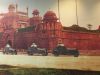
Armoured cars in Delhi145 viewsRead about them on a dedicated CRossley site
PICT1722.JPG
Carden Lloyd Mk IV145 viewsThe Carden Loyd tankettes were a series of British pre-World War II tankettes, the most successful of which was the Mark VI, the only version built in significant numbers. It became a classic tankette design worldwide, was license-built by several countries and became the basis of several designs produced in several different countries.
PICT1778.JPG
Panther145 viewsThe Panther's excellent combination of firepower, mobility, and protection served as a benchmark for other nations' late war and post-war tank designs, and it is regarded as one of the best tanks of World War II
IMGP0617.JPG
WW1 British tanks144 viewsThe British Mark I-V series were tracked vehicles developed by the British Army during the First World War, and the world's first combat tanks. Born of the need to break the domination of trenches and machine guns over the battlefields of the Western Front, they were the first vehicles to be named "tank", a name chosen as an expedient to maintain secrecy and to disguise its true purpose. It was developed to be able to cross trenches, resist small-arms fire, travel over difficult terrain
PICT1720.JPG
Lanchester Armoured Car144 viewsBy 1939, most Lanchesters (13 Mk I, 1 Mk IA, 5 Mk II, 3 Mk IIA) were sent to the Far East and assigned to the Selangor and Perak battalions of Federated Malay States Volunteer Force, the Singapore Volunteer Corps, Straits Settlements Volunteer Force and the 2nd battalion of Argyll & Sutherland Highlanders in Malaya. Some of these took part in the Malayan Campaign (December 1941 - 15 February 1942) against Japan.
270 files on 27 page(s) 1 - 12 13 14 15 16 17 18 19 20 21 - 27


Visit Madaxeman on

Youtube Logo
Blogger Logo
Facebook Logo
Podbean Logo
Twitter Logo
Spotify Logo
Pinterest Logo
iTunes Logo
Tune In Logo

Podcasts to download from Madaxeman.com

(Also available on Podbean, iTunes and Spotify)


(These are "affiliate links". If you buy something after clicking on them I get a small kickback from eBay)

Page Loads for the 10mm & Museums Gallery:

About This Site & Privacy Information

Powered by Coppermine Photo Gallery