

Dark Ages at Kegworth 2026
Thematic Byzantine vs Khmer
Game 1 Thematic Byzantine vs Khazar
Game 2 Thematic Byzantine vs Khmer
Game 3 Thematic Byzantine vs Alan
The second game of Codgers 2026 saw the Byzantines fighting another mighty empire - the Khmer of Angkor Wat all the way from sunny (or rainy, depending on the season) Cambodia, led by Bristol's foremost Khemeric expert and author, Mr Mark "G" Fry.
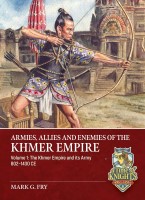 Armies, Allies and Enemies of the Khmer Empire (Volume 1: The Khmer Empire and its Army 802–1430 CE) by Mark G. Fry is a recent addition to Helion’s A Time of Knights 400CE–1453CE series, focusing on the Khmer Empire and the army that sustained its power.
Moving beyond the familiar imagery of Angkor Wat, Mark presents the Khmer as a sophisticated and adaptable military power. The book examines how the army was organised, from elite palace guards to peasant levies, alongside its weapons, armour and use of elephants. Particularly interesting are the sections on war elephants, elephant-mounted ballistae, composite bows and even early black-powder weapons, as well as the challenges of campaigning in the monsoon-dominated landscape of Southeast Asia.
One of the book’s greatest strengths is its superb visual material. The specially commissioned colour plates are vivid and carefully researched, drawing heavily on the bas-reliefs of Angkorian temples, while numerous black-and-white photographs provide useful evidence for the reconstructions.
The book should appeal particularly to historical wargamers, miniature painters and anyone interested in military reconstruction, with plenty of useful detail on the appearance and organisation of Khmer forces. Accessible and informative without becoming overly academic, it is an excellent introduction to a fascinating military tradition that lies well beyond the usual medieval European focus.
And yes, there are elephants — which certainly doesn’t hurt.
This was on paper not a great matchup for the Byzantines, as armies festooned with elephants are generally Kryptonite to cavalry forces like the Byzantines.
I had also omitted to bring any dismounted figures along to this event too, so my horsemen would remain mounted even though getting off their horses when faced by elephants would be (rules wise) a bit of a no-brainer.
L'Art de la Guerre hint - Elephants, War Wagons and fortifcations/obstacles of any kind are all so toxic to anything on a horse that ADLG allows any mounted troops to be swapped out for infantry "dismounts" if any of these nasties appear in the enemy army at deployment.
In this matchup the ability of the Tagmatic cavalry to shoot and evade, and the relative lack of shooters in the Khmer army meant that I was probably best off staying mounted with most of the horsemen in the list - but the 2 Georgians, being Impetuous and thus unable to evade or shoot, would have been prime candidates to dismount. If I had brought the figures along, swapping them out for two units of 3-hit Heavy Infantry Spearmen with Armour would have been great - OK, the Armour does not count against Elephants, but Heavy Spearmen are OK to face them down - and Armour would still give them a key advantage against Khmer Infantry and archers too.
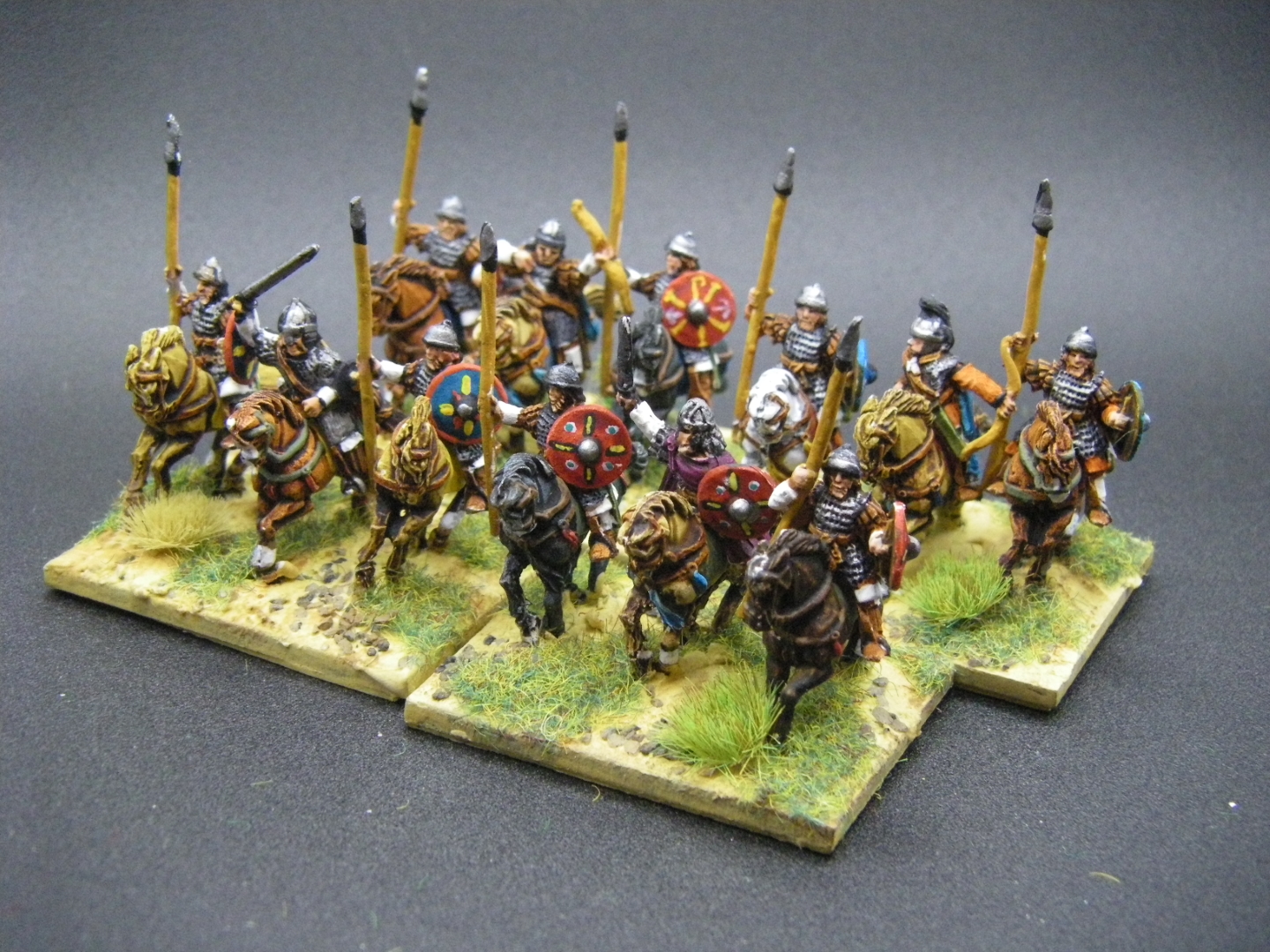
The Khmer army list in L’Art de la Guerre reflects the diverse and distinctly non-European character of the armies described in Mark "G." Fry’s book. Its core is built around large numbers of infantry, supported by powerful elephant units and a selection of lighter troops.
The elephants are, naturally, the stars of the show, representing the important battlefield role played by Khmer war elephants and their crews.
The list also includes the characteristic Khmer combination of missile and close-combat troops, but with more "vanilla" swordsmen than bowmen (which is a bit of a minor win for the Byzantines), while lighter troops represent the forces suited to operating in the difficult terrain and campaigning conditions of mainland Southeast Asia.
Overall, the Khmer army offers a colourful and unusual combination of massed infantry, elephants and supporting troops, making it both an interesting historical force and a very distinctive army to field on the ADLG tabletop.
The lists for the Thematic Byzantine and Khmer from this game, as well as all the other lists from the games at Kegworth can be seen here in the L'Art de la Guerre Wiki.
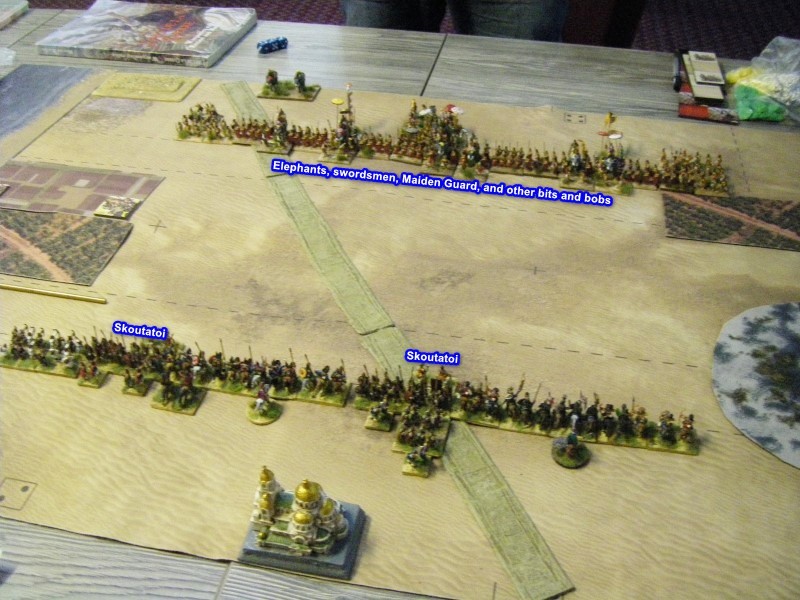
The terrain fell terribly for the Byzantines, but great for the army of Mark "G" Fry. On one flank, a sluggish waterway curled around a Khmer village, while on the other stretched a dense South-East Asian marsh, doubtless alive with snakes, caymans and other creatures best left undiscovered by a Byzantine soldier.
This confined the battle into a broad central killing ground, allowing Mark "G" Fry's exotic Khmer army to fill almost the entire open space with alternating ranks of brightly equipped infantry and towering war elephants.
The Byzantines, immaculate in their smartly ordered uniforms and accustomed to the disciplined precision of Imperial warfare, were therefore forced into a rather obvious plan.
A flank march would head off to the right, telegraphing its intentions to anyone with functioning eyesight, while the main body advanced cautiously towards Mark "G" Fry's Khmeric lines.
L'Art de la Guerre hint - I had set my list up with a small, 3-strong command of 2 Thematic Cavalry and a lone light horse archer, with the commander included in one of the cavalry units. This would typically deploy first of hree commands so as not to give too much away to my opponent, or could be sent on a flank march without massively weakening the rest of the army in it's absence.
The Commander was only Ordinary in this command, leaving 2 Brilliant commanders on table who had more than enough command capability to drive the rest of the army around on their own with some aplomb
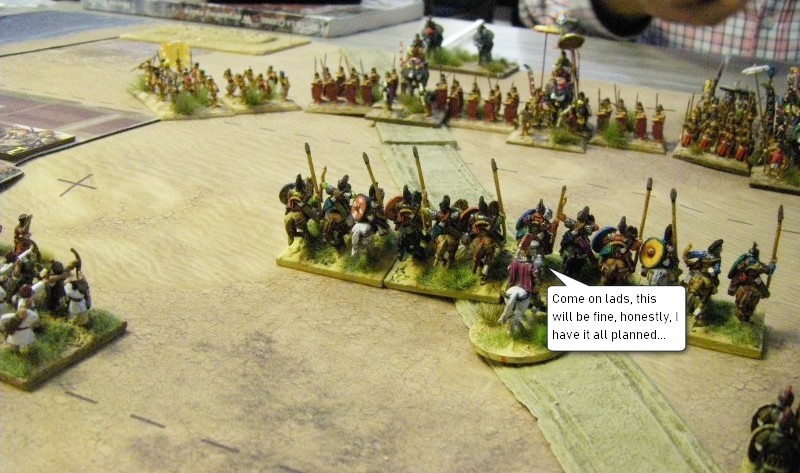
The Byzantine cavalry rode forward ready to shoot at the colourful Cambodian warriors, fully expecting to have to evade from Mark "G" Fry's Khmer elephants many times before again returning to the fray.
Meanwhile, the sturdy Skoutatoi knew that their fate was to stand between the Empire and a herd of enormous elephants.
Their rear ranks of archers would have to distract the beasts and blunt their terrifying charges, while the Thematic Cavalry eagerly anticipated their favourite opponents: the Khmer Medium Swordsmen, rather less intimidating than the elephants and considerably easier to stab.
L'Art de la Guerre hint - The Skoutatoi have "Rear Support", which I now mark with a small 20x20 base with 2 archers on it sat behind the unit itself. This gives two key capabilities to the Spearmen: They get an extra +1 if they lose a combat in the first round where they have stood to receive a charge, and they are also never subject to the "extra hit" that comes when a mounted enemy with "Furious Charge" ability beats them in a first round combat. As a 4-hit unit, this extra resilience can often eke them out one or two more turns more of survival against mounted opponents, helping them soak up the most dangerous troops in the enemy army while the Thematic and Tagmatic cavalry try and win elsehere.
Rear Support however doesn't give immunity to "Furious Charge" when fighting against Impetuous infantry, only against mounted opponents - an easy one to forget, unless of course you are the owner of the Impetuous infantry!
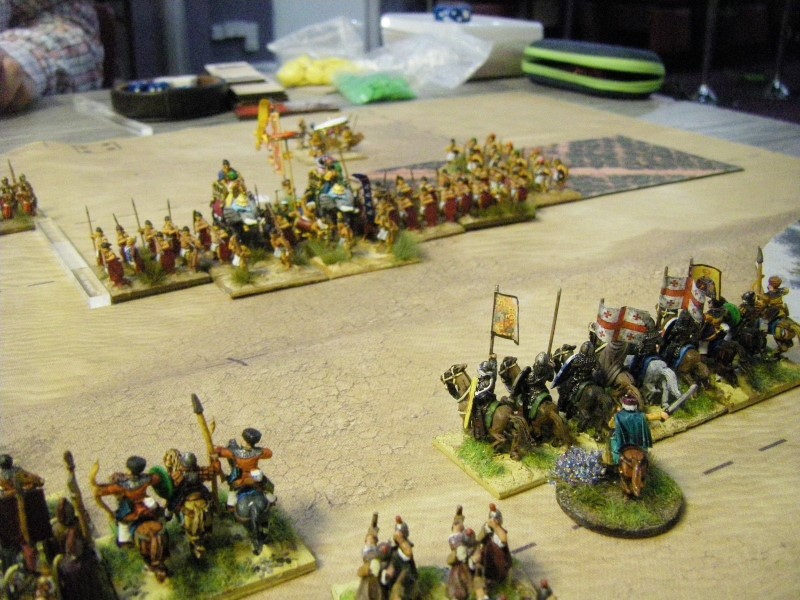
On the Byzantine wing, the Impetuous Georgians pushed forward with considerable enthusiasm, fuelled by Georgian wine and the heroic certainty that somewhere nearby must be an enemy worth charging.
The Khmer line was wider than its elephant screen, leaving some colourful archers exposed in a field.
This might have looked like an inviting target, although the somewhat stumble-prone Georgians were hardly at their best in such terrain anyway.
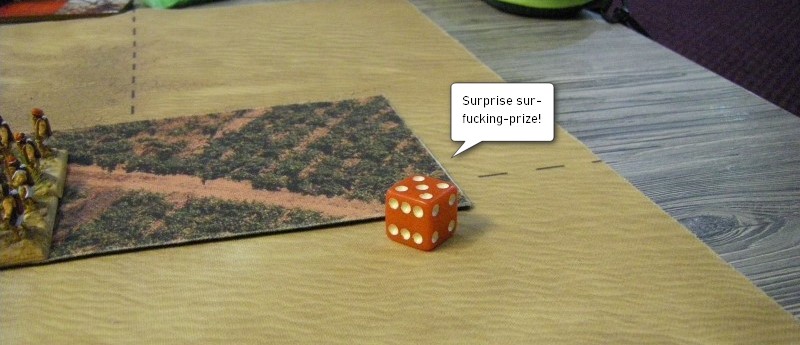
Then the Byzantine flank march arrived, right on cue.
More Imperial cavalry would soon be appearing dramatically behind Mark "G" Fry's Khmer lines, presumably to the sound of trumpets and the increasingly nervous muttering of Cambodian commanders.
Khmer Soldiery
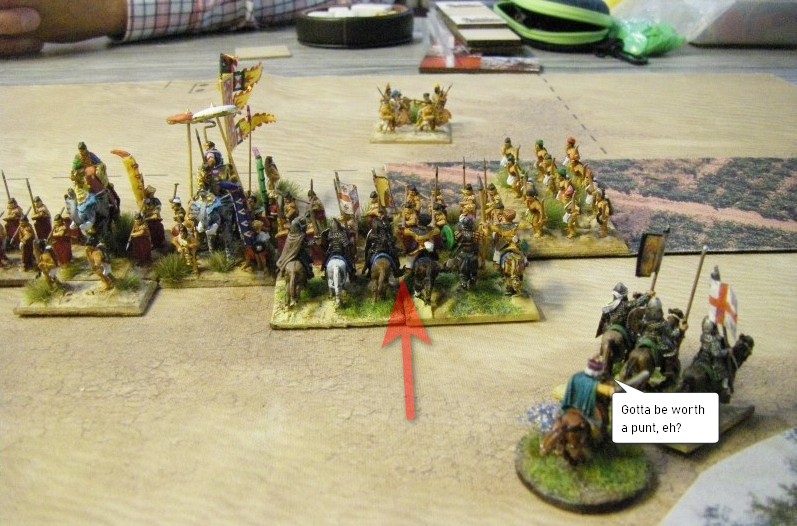
The wine-fuelled Georgians were not short of self-belief either, and some joined the Elite Byzantine Cavalry in an immediate charge against those of Mark "G" Fry's Khmer infantry foolish enough to emerge from their terrain.
Yet even these hardy horsemen were unsettled by the looming elephants. Their unfamiliar smell and thunderous presence disturbed both horses and riders, providing a distinctly unpleasant accompaniment to the battle.
L'Art de la Guerre hint - Cavalry touching an elephant in combat, even only at a corner, are subject to a -1 for Elephant Panic - they are also not obligated to charge at targets if they would end up in contact with an elephant in any way.
My reckoning in this scenario was that the -1 for elephants, and a further +1 to the opposition for overlaps was still a price worth paying for the opportunity to charge into some Medium Swordsmen in the open with mounted lancers. The Georgians would be at a base factor of 2 (Cavalry vs foot, Impact) reduced to 1 for the Elephant, against the infantry's factor of 2 (Infantry factor, overlap).
The Georgians better Armour, and better "Elite" status would however largely cancel out the net -1 balance of factors, and were they to win the "Furious Charge" effect could see them knock at least 2 hits ini the rather squishy 3-hit Khmer infantry too.
The elephants would also have to think twice about advancing past this scrimmage in their next turn, as they were adding more to the combat than the infantry doing the fighting - again buying time for the rest of my army by halting the advance of the mighhty beasts, at least for a while.
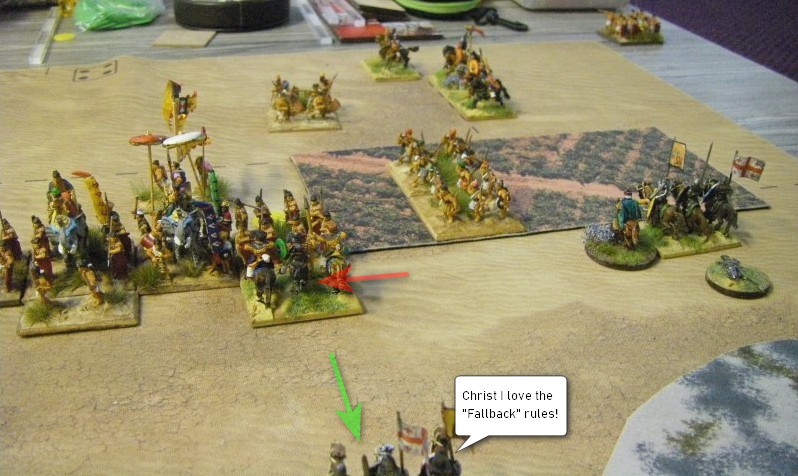
The fighting was fierce. Mark "G" Fry's Khmer infantry stood stubbornly beside the elephants, wielding their exotic weapons and colourful shields while battering the Georgians, even as their immediate neighbours were ridden down by disciplined Byzantine horsemen.
The Georgians eventually fell back in disorder, leaving the elite Imperial cavalry to continue the struggle alone.
L'Art de la Guerre hint - Cavalry can always "break off" from enemy infantry in combat - this was the other reason that I thought attacking here was worth a punt, as the Georgians, as long as they survived two rounds of combat until my next turn, could then fall back and maybe get away entirely from this now rather messy situation!
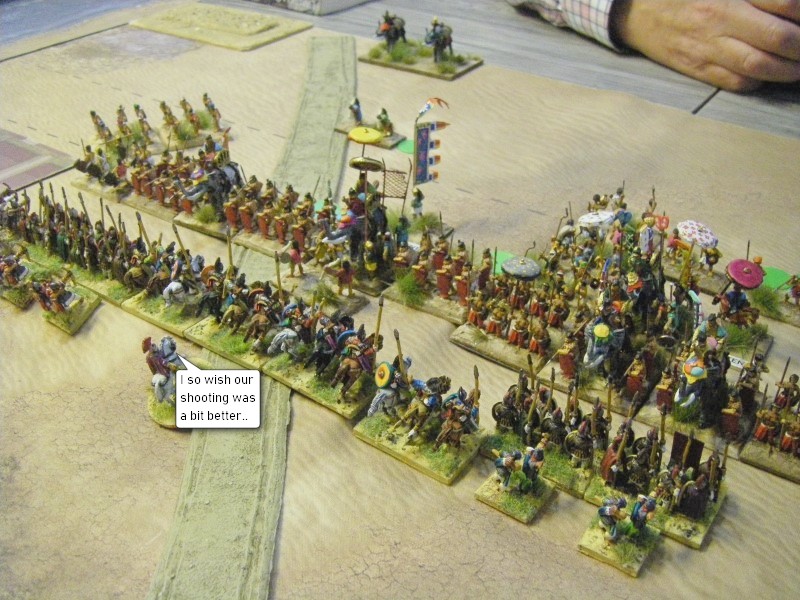
Across the rest of the battlefield, the two empires were now closing for the decisive clash. Lines of brightly clad Khmer warriors and impeccably equipped Byzantine troops shouted, gestured and prepared themselves for slaughter.
Elephants, infantry and what Mark "G" Fry assured me were historically anachronistic Maiden Guard formed the Khmer line, while ranks of precise Byzantine cavalry and solid Skoutatoi prepared to meet them.
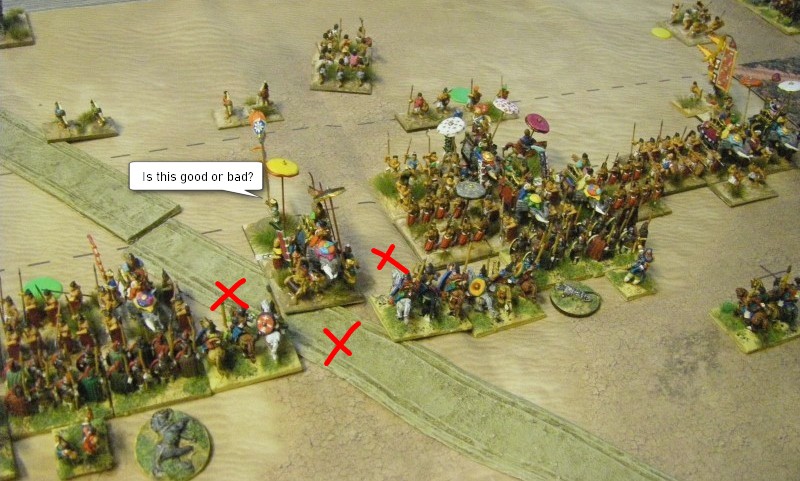
 Both sides seized the initiative. The Byzantines somehow persuaded their understandably reluctant and increasingly cowering Skoutatoi to move forward directly into the path of the elephant herd.
The Byzantine spearmen stood firm as the great beasts thundered towards them, while Imperial lancers swept aside Mark "G" Fry's more vulnerable Khmer swordsmen, whose talents were perhaps better suited to jungle warfare than standing beneath the hooves of proto-medieval heavy cavalry.
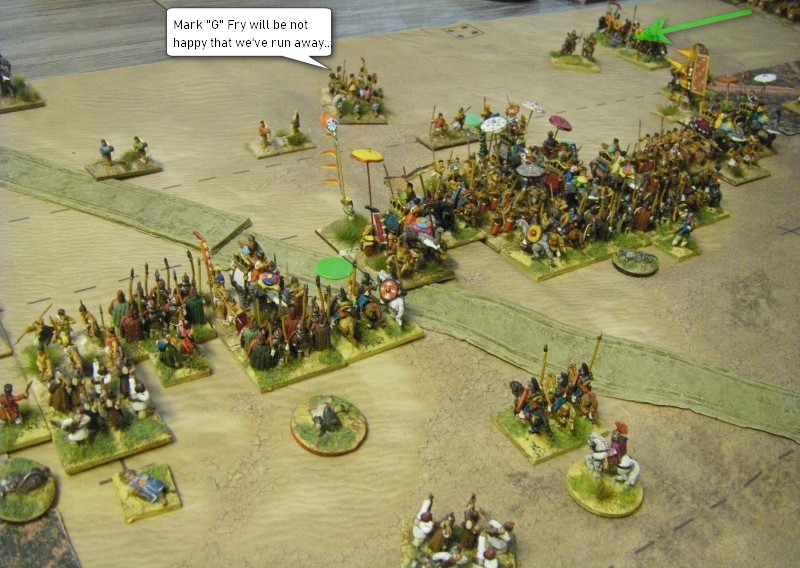
For a while, the story of the battle was the extraordinary resilience of the Skoutatoi.
Rank after rank stood their ground against the elephants, their discipline and shields holding back beasts many times their size.
Elsewhere, however, the Byzantines struggled to turn their mounted breakthroughs into anything decisive, as every time they appeared to have created an opening, another one of Mark "G" Fry's Khmer elephants seemed to rush forward and materialise in front of them.
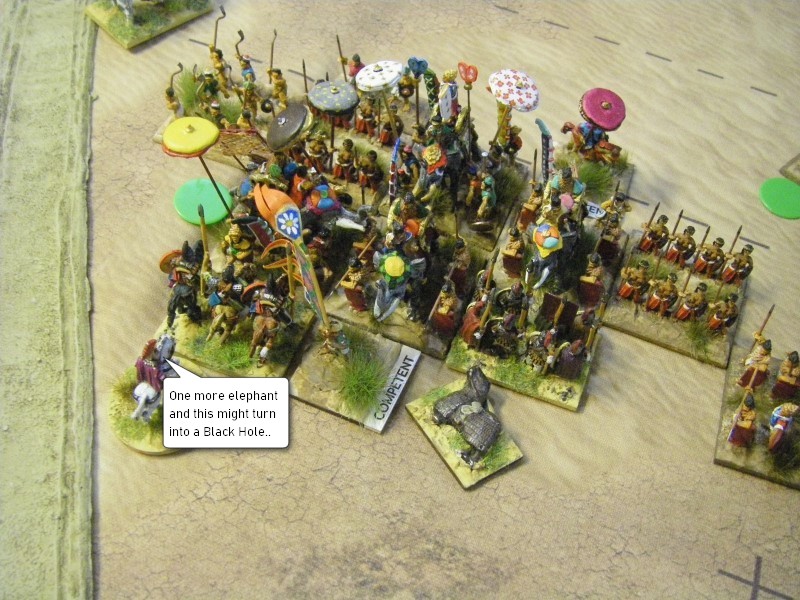
At the very centre of the battlefield, everything finally dissolved into glorious chaos. Elephants, infantry and cavalry became one enormous, confused knot of men and animals, with everyone striking in every direction and presumably hoping that the person they were hitting was actually an enemy.
Mark "G" Fry's dreaded Elephant Rampage markers appeared in abundance, threatening catastrophic consequences for either army should the pips fall the wrong way.
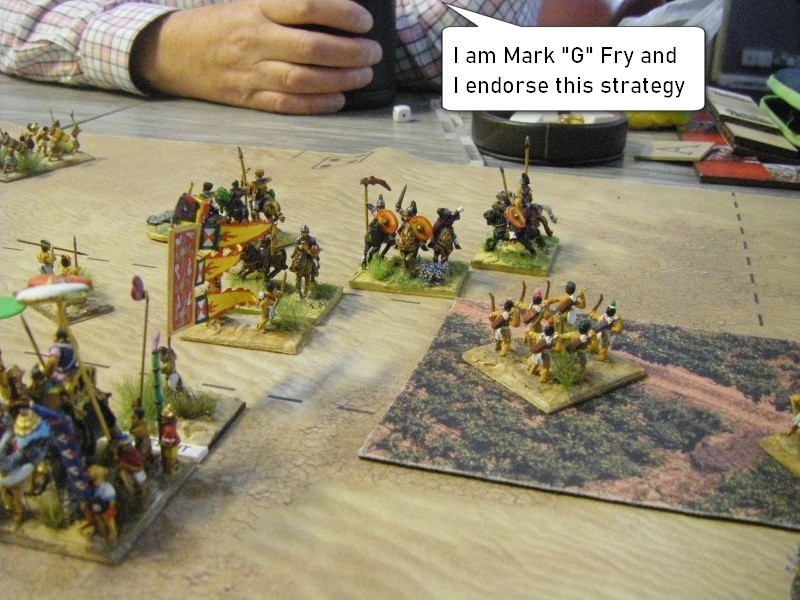
Meanwhile, the Byzantine flank march was proving somewhat less spectacular than advertised. Although it had arrived early, it struggled to find suitable targets.
Mark "G" Fry's Khmer infantry had sensibly taken refuge in cavalry-unfriendly fields, making themselves effectively immune to the Byzantine horsemen.
The magnificent flank march therefore began to look less like a devastating surprise attack and more like an expensive mobile archery target.

 Armies, Allies and Enemies of the Khmer Empire Volume 2: Allies, Subjects and Enemies of the Khmer Empire is an extraordinary sequel that somehow manages to improve upon the already impressive Volume 1 by adding even more Khmer history, more exotic warriors and, most importantly, several features that no serious military history book has ever thought necessary before.
The research is, as one might expect, outstanding, but the real innovation comes in the production values. Turn the page and an enormous three-dimensional Angkorian pagoda rises majestically from the book. Turn another and a fully formed Khmer elephant emerges from the gutter, apparently requiring several minutes to calm down before you can continue reading.
The elephant chapter is particularly impressive. Not only are there detailed illustrations showing saddles, armour and battlefield equipment, but a revolutionary “scratch-and-sniff” feature allows the reader to experience the authentic aroma of a Khmer war elephant. The publishers have thoughtfully included a warning that this may be best appreciated outdoors.
The sections on the Khmer Empire’s allies, subjects and enemies are equally comprehensive. There are fold-out maps, rotating army commanders, miniature enemy ambassadors and, apparently, a small bell which must be rung whenever the text mentions the Champa–Khmer wars. One particularly ambitious double-page spread allows the reader to recreate the entire Mekong Delta simply by pouring water onto it.
For the historical wargamer, this is essential reading. The book apparently includes detachable 15mm elephants, a pop-up jungle, a working monsoon, and a fold-out battlefield complete with tiny Cambodian archers who can be flicked towards the enemy with a finger. The appendix even provides a suggested army list for readers wishing to recreate the campaign immediately after breakfast.
In short, Volume 2 is a triumph of scholarship, engineering and questionable publishing decisions. It is informative, colourful, interactive and faintly dangerous. Quite possibly the greatest book ever written about the Khmer Empire — although I would advise keeping Volume 1 nearby, just in case the scratch-and-sniff elephant escapes.
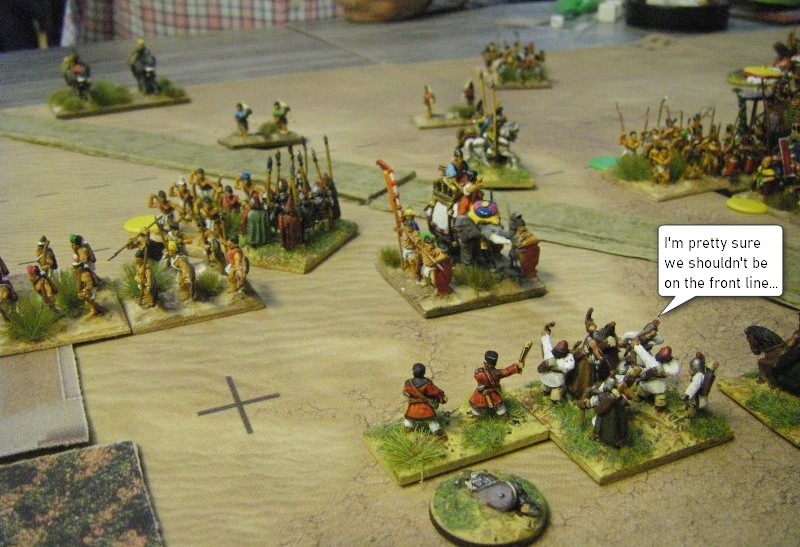
Eventually, Mark "G" Fry's Khmer army began to dissolve, although the Byzantines had paid a terrible price in the process.
Their own losses were mounting rapidly, and the battlefield was now scattered with the wreckage of both armies. Victory could still have gone either way.
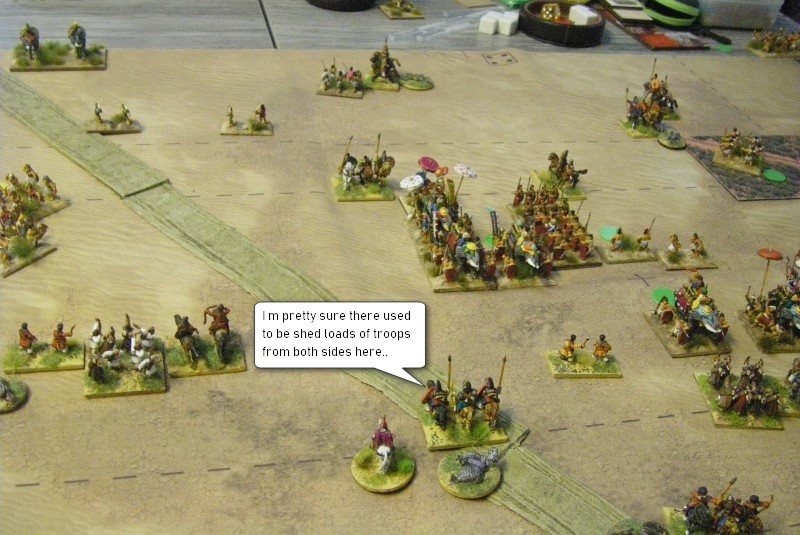
And so, by the finest of margins, the Byzantine Empire emerged victorious over Mark "G" Fry's armies of Angkor Wat.
The battlefield was left strewn with the bodies of men, horses and elephants from both sides: a hard-fought Imperial victory achieved through disciplined Skoutatoi, determined cavalry and just enough luck to survive Mark "G" Fry's legendary Khmer elephant rampage.
The Result is a second win, only just, for the Thematic Byzantines!
Click here for the report of the next game in this competition, or read on for the post match summaries from the Generals involved, as well as another episode of legendary expert analysis from Hannibal
Post Match Summary from the Thematic Byzantine Commander
 My magnificent Thematic warriors! What a glorious day for the Empire! Another enemy has been defeated, another battlefield has been conquered, and once again the wisdom of your commander has been magnificently demonstrated. Some may say Mark "G" Fry's Khmer came dangerously close to defeating us. I prefer to say that I deliberately allowed them to come dangerously close, thereby giving our victory a much more dramatic conclusion.
Look at what we achieved! Our magnificent Skoutatoi stood firm against elephants of terrifying size and questionable personal hygiene. Our splendid cavalry swept aside Khmer swordsmen with the precision of a well-oiled Imperial machine. Our impeccably dressed soldiers maintained their discipline while surrounded by exotic Cambodian warriors, war elephants and enough jungle wildlife to make a lesser army reconsider the entire expedition.
And let us not forget the flank march! Yes, it arrived precisely when required. It then spent much of the battle looking for something useful to attack, but that was entirely intentional. We were keeping the enemy nervous. They were constantly wondering what those cavalrymen might do next. Admittedly, so were we.
The Georgians, fuelled by their customary courage and an entirely reasonable quantity of Georgian wine, also played their part. They charged magnificently, retreated magnificently, and then allowed the Elite Cavalry to continue the work. This is what we call combined arms. Or, in Georgia, probably combined drinking.
And once again I say this: surely nobody can now doubt that the Thematic Army deserves its own theme tune! We have defeated Mark "G" Fry's Khmer! We have survived their elephants! We have stood firm beneath the banners of the Empire! Surely such achievements demand music!
I have therefore been working on the composition already. I believe it should begin with a solemn Byzantine trumpet fanfare, followed by pounding drums, the clash of shields and perhaps the distant trumpeting of a very confused elephant.
And, naturally, I shall sing it myself.
“The Thematic Theme – Verse Two”
Against the Khmer we proudly stood,
Their elephants charged as elephants should,
Our Skoutatoi held, our horsemen rode,
And sent Angkor's warriors down the road!
There! You see? It is already a masterpiece. I am confident that once the rest of the army hears it, the enemy will either flee in terror or surrender simply to make me stop singing.
So remember this glorious victory, my friends: discipline, precision, immaculate uniforms, courageous cavalry and an absolutely brilliant commander. The Empire marches on — and apparently, it now marches to music!”
Hannibal's Post Match Analysis
Hear me, ye Thematic bunglers of Byzantium, ye commanders of the Army of Newly Painted Regret! I, Hannibal the Nasty—terror of incompetence, scourge of half‑baked plans, and patron saint of “What in God’s name were you thinking?”—do now deliver my verdict upon thy lamentable performance against Mark "G" Fry's Khmer. By the sacred nostril hair of Saint Maurice, never has an army arrived so proudly, so colourfully, and so catastrophically unprepared.
First, thy failure to bring dismounted options. O thou saddle‑witted simpleton, thou horse‑hugging hobbledehoy! Thou didst paint half the cavalry in Christendom, yet forgot the one thing the Thematic army actually needs: the ability to get off the horse. The Khmer brought elephants, infantry, bowmen, and fields—fields, I say! And thou didst respond with, “Nay, I shall remain mounted, for dismounting is for those who think ahead.” Truly, thou art a strategist of the School of Staggering Stupidity.
Then, thy flank march. Yes, yes, sending it was obvious—so obvious that even a goat with a head injury would have done the same. It was not a decision; it was a reflex. And yet, despite being the most predictable manoeuvre since “walk forward and hope,” it achieved almost nothing. Outsmarted by bowmen sitting in a field! O thou field‑fearful flapdragon, thou meadow‑muddled mooncalf! Thy flank march was not a dagger in Mark "G" Fry's back; it was a spoon gently tapping their elbow.
And what of thy Elite Georgians? Those proud, fierce warriors, forged for glory and carnage. How didst thou employ them? By planting them in front of a field and letting Khmer bowmen shoot them all afternoon like a carnival attraction. O thou cabbage‑headed clodpate, thou dolt of the Ditch! The field did not ambush thee; it merely sat there, quietly, while thou marched thy finest troops into the perfect position to be perforated. This is not misfortune—it is self‑inflicted idiocy.
Once again, thy plan: a solid line of everything attacking almost all at once. Really? Is that it? O thou line‑loving lackwit, thou formation‑fixated fustilarian! Must every battle resemble a child’s drawing of “My Army”? The Khmer brought elephants, depth, terrain, and cunning. Thou brought a straight line and a prayer. Even the dice rolled their eyes.
The Thematic army can evade and shoot—this is its strength, its soul, its very reason for existing. And yet thou didst neither. Why? Because thou dragged thy infantry up with thy cavalry like a drunken shepherd hauling sheep into a river. Instead of breaking up Mark "G" Fry's Khmer line, thou didst present his men (and ladies) with a neat, tidy target. Mark "G" Fry's elephants trumpeted with joy at the convenience.
Some manoeuvre, some dismounting, maybe holding back, maybe shooting—these were not obscure ideas hidden in dusty manuals. They were obvious, glowing, screaming options. And thou ignored them all. O thou witless whey‑face, thou blundering barnacle! Thou didst nearly lose a battle that the Thematic army is practically designed to win. Mark "G" Fry's Khmer did not defeat thee; thou defeated thyself, and the elephants merely applauded.
Thus I, Hannibal the Nasty, proclaim thee: Grand Marshal of Missed Opportunities, High Lord of the Unused Dismount, and Emperor of the One Long Line of Doom. May future battles see thee deploy with thought, shoot with purpose, and dismount with something resembling intelligence. Until then, remember: Mark "G" Fry's Khmer did not outplay thee—thou outplayed thyself, and so badly that I would be surprised if you even make it as far as the .
next game !Click here for the report of the next game in this competition
You may also like....
Game 1 Thematic Byzantine vs Khazar