

Rome's Frenemies at Warfare 2025
Numidian vs Late Imperial Roman
Game 1 Numidian vs Ancient British
Game 2 Numidian vs Late Imperial Roman (Italian)
Game 3 Numidian vs Late Imperial Roman (French)
Game 4 Numidian vs Late Imperial Roman (English)
Game 5 Numidian vs Bosporan (quite near Derby)
With Battle #1 successfully negotiated, and a degree of confidence starting to seep into my little-tested Numidian forces it was time to take on the test of facing the Massimillianian Might of Martelluccian Rome!
With so many Roman armies in the field this was an enemy I probably should have thought more about how to deal with, but the disparate elements of the Numidians needed different terrain options to flourish, so it was with some degree of experimentation that I opted to Defend in the Steppe terrain of the North African plains having won the Initiative roll against the Italian foe.
What I mean by that is that my army has (of course) lots of Cavalry & Light horse - which would tend to favour a very open, clear battlefield, but also a block of 5 units of Heavy Swordsmen Imitation Legionaries + an Elephant, who's job is to act as a resilient sponge to occupy and grind down the enemy's best troops.
These guys need an obvious place to stand, ideally with a secure flank - ideally which means a patch of difficult terrain, which is terrible for cavalry.
Oh, and of course, there is another Elephant, 2 Impetuous Spanish warriors and a couple of Numidian Javelinmen, all of whom do kinda need some rough or uneven ground to march through otherwise they too end up too vulnerable to any enemy cavalry.
So, the army sort of needs an open table with areas of difficult, and also some uneven and rough.
But not too much of any of it.
The lists for the Numidian and Late Imperial Roman from this game, as well as all the other lists from the games at Warfare can be seen here in the ADLG Wiki.
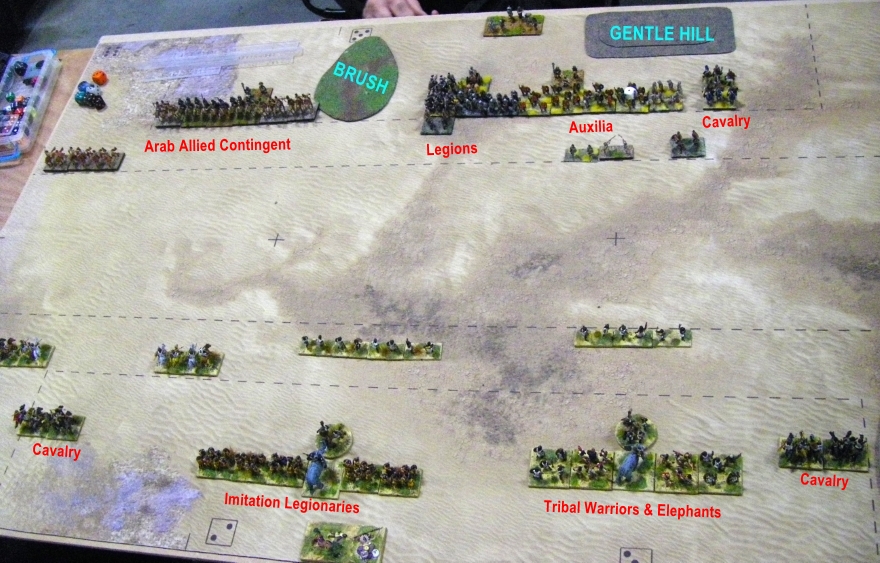
In the end, the choice of Steppe terrain meant I was playing on an almost-bare battlefield, in the expectation that a Late Roman Army would be both much smaller than mine, and would be seriously undercooked in terms of the number of mounted units in it.
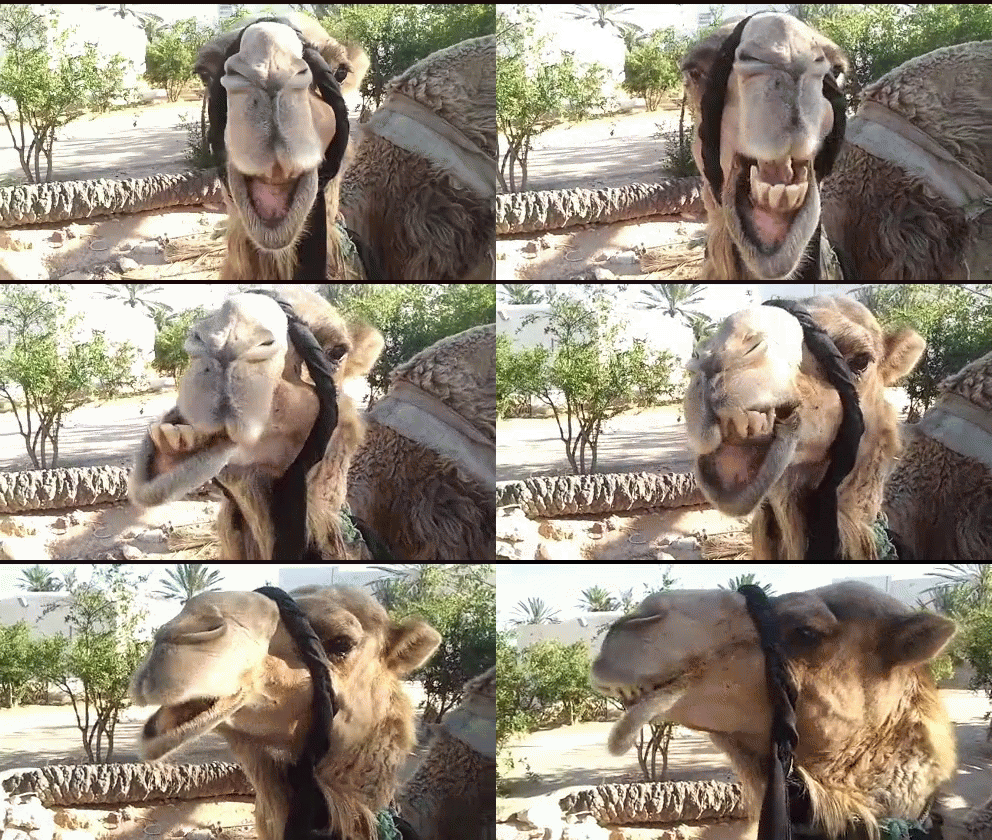
That was a great theory, which only survived until the Romans deployed their third command - an Arab allied contingent made up of 6 Camels and 3 Light Horse - totally outclassing the small mounted command I had dropped opposite it!
Suddenly the "open table" theory looked like one designed by my opponent, not me!


On The Left: The Arabs immediately steamed forward as my forces reeled in shock at the sheer unexpectedness of facing a Camel-infused Arab ally, a shock made even more acute by the fact I had used exactly the same trick earlier this year at Roll Call with the exact same ally in a Sassanid army.
Fortunately my whole army had been deployed some way back from the "start line" (aka the edge of the deployment zone), buying me a little more time to stitch together a plan to deal with this enormous wodge of cavalry-defeating dromedaries and their beturbaned riders.
These Arabs were the children of horizons — born wherever the sky met the sand - and on this particular cloth from Rafa there clearly was a lot of sand indeed.
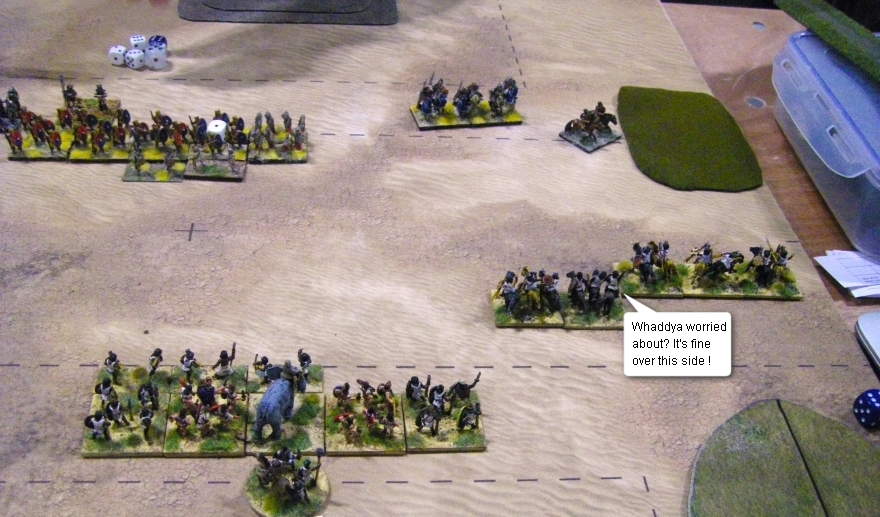
 On The Right: On the other flank things looked better, with the Numidians enjoying more numbers (but less quality) in the Cavalry matchup, and an intriguing confrontation between Supported Auxilia and the Numidians Elephant/Spaniard Death Star in prospect.
The Romans had a sole unit of Legionary archers tucked into their line too - devastating against the totally unarmoured Numidian horsemen, making them a strong support piece for the Roman cavalry, but also highly vulnerable should almost any of the Numidian troops actually get into contact with these pasta-loving bowmen.
Numidian Facts - Some units were trained falconers, releasing birds during manoeuvres to confuse enemy formations. A later historian added that these birds could “recite the names of fallen kings,” suggesting either deep symbolism or a complete lack of fact-checking.
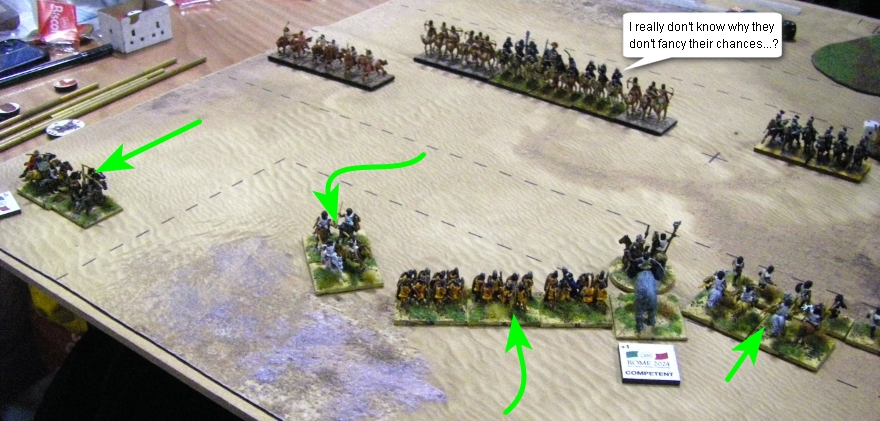
On The Left: Faced with such numbers of Camels there was little for it other than a cowardly retreat for the cavalry on my left flank.
With the Imitation Legionaries wheeling outward to form a solid wall of shields, the handful of Numidian horsemen started to fall back as fast as they could, ideally to squirt behind their infantry but if the Arabs unsportingly did not give them time to do so, at least to split up the wall of dromedaries before they arrived at the gates of Numidia
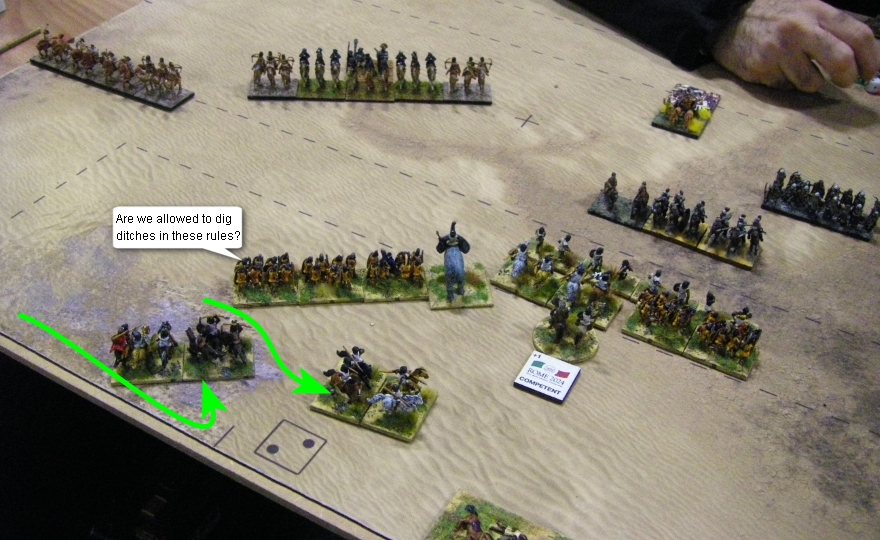
On The Left: A moment of hesitation from the Arabs, perhaps checking that the Romans had actually paid them before committing to personal danger, and the Numidian defensive line was now about as good as it could get in the rather unexpected circumstances, with the almost impenetrable wall of infantry shored up on either end by the Elephant and a couple of Cavalrymen led by the Commander of the Small Command.
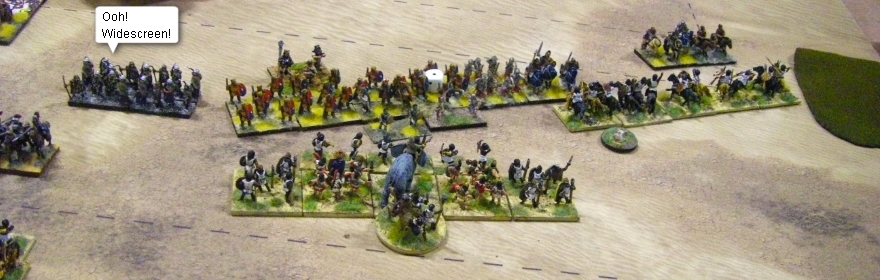
On The Right: This focus on both flanks had rather left some of the Roman Legionaries with no opponents in the centre, and keen to engage the enemy before these bastions of Roman Civilization could rejoin the fray the right wing of the Numidian army pressed forward at speed.
Having managed to extend all of the mounted elements into a solid line there were now opportunities to push Light Horsemen through some of the gaps in the enemy lines, but matching up against the Auxiliaries had meant that some of the rather combat-phobic Numidian Javelinmen suddenly found themselves apprently marked down to fight alongside the much more martially potent Spaniards and Elephant Death Star.
Rome vs the Numidian Kingdom
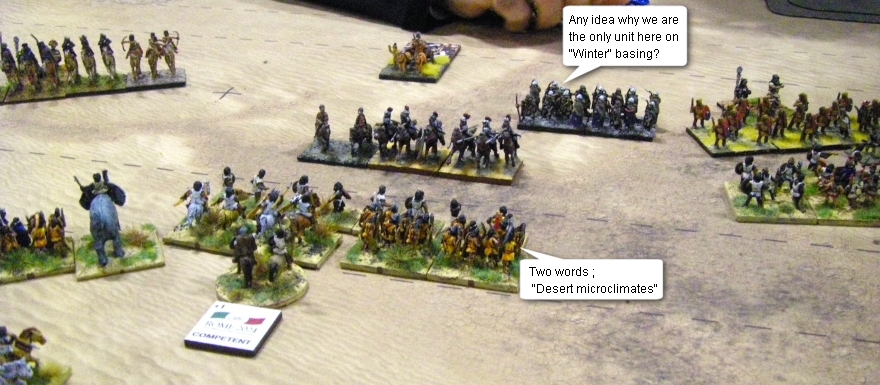
In The Centre: Stretching across an almost terrain-free table had left the Numidian Centre somewhat denuded of troops, with the line of Imitation Legionaries who were supposed to have been here now split up and tasked mainly with preventing the left wing being overrun by the wall of Camels behind whom a cloud of dust now rose like a second sky — a storm of horse-whipping camel scent they carried with them into battle.
The remaining Mock-Legions rushed forward to try and distract the attention of yet more Roman lance-armed cavalry, with the rather optimistic support of even more Numidian skirmishers on foot and horseback
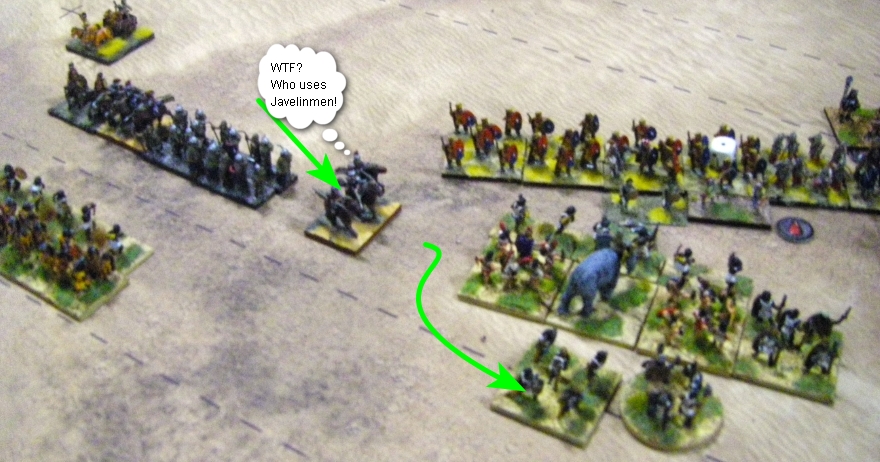
On The Right: The Romans spot an opportunity, and despatch one of their horsemen from the centre to charge the flank of the Numidian Death Star Line! But, aha - the Numidians unleash their secret weapon, as the utter uselessness of the concept of having Javelinmen in the front line bamboozles the Romans, who simply had not imagined that the infantry who were the targets of their charge may be a type capable of evading away!
OK, its still not left the best position any army has ever been in, but at least its split up the Roman cavalry in the centre, and the Numidian right has a turn or two to try and deal with the isolated and frustrated Italiote lancers too.
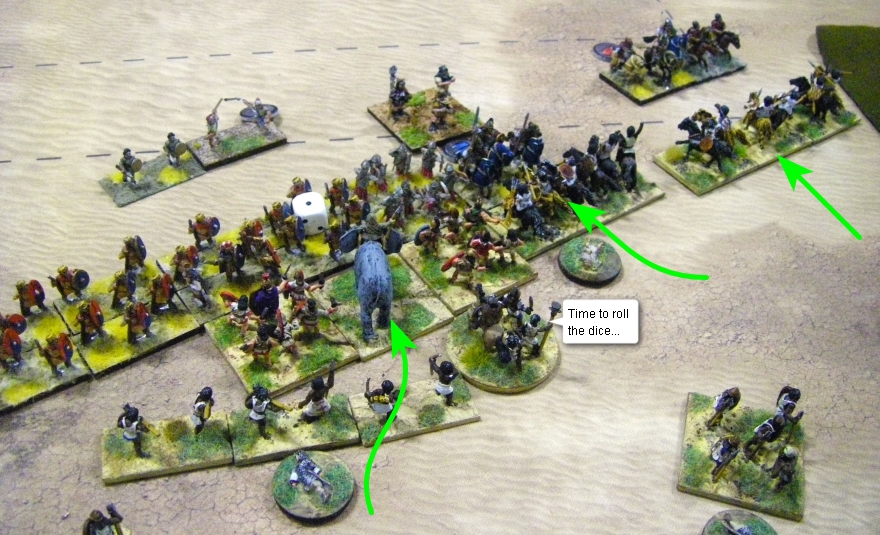
On The Right: With a flank hanging out to dry, the Numidian right goes into battle, leaving behind both units of Javelineers to form a fairly solid line of supposedly combat-capable troopers to hurl at the Roman Auxilia and cavalry.
They need a quick result here - or at least a bit more time to squeeze some Light Horse in behind the line of enemy troops.
Numidian Facts - After battle, the Numidians gave thanks to both the sun and the wind, their twin patrons. Roman chroniclers, misunderstanding the ceremony, assumed they were shouting at the weather — which, to be fair, might have been equally effective.
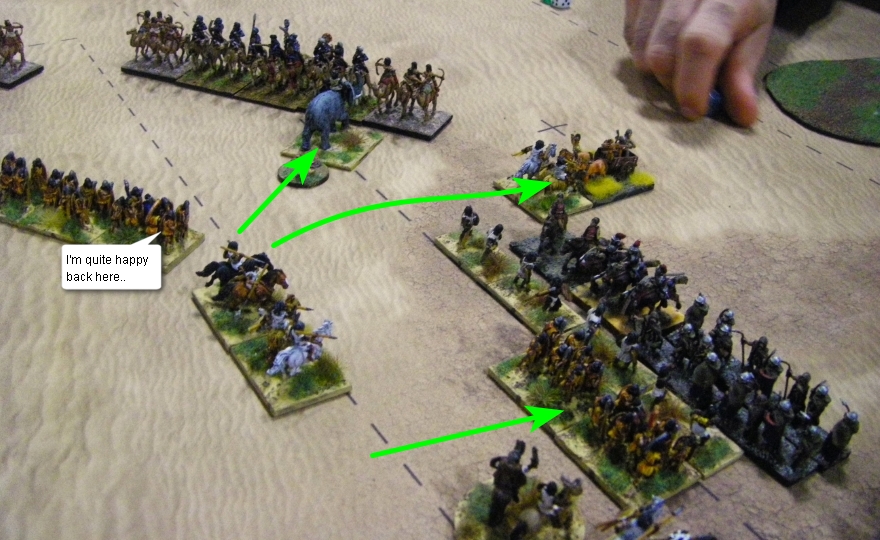
In The Centre: With the Roman cavalry still becalmed by puzzlement, the rest of the Numidian centre now stepped up sharply, pinning the Real Legionaries so thoroughly that a lone unit of Numidian Light Horsemen found space to sweep through the enemy lines and engage the cart-mounted bolt shooter which had been left behind by the Romans too-rapid advance across the open plains of the Numidian desert.
To the confused Roman Legionaries, these fast moving horsemen seemed not men but the ghosts of Africa’s old gods, sweeping in ineffectually to try and take the threat of a torsion powered javelin to the stomach out of the equation of this particular battle.
Obviously though, this was the moment the bolt shooter decided to become a close combat demon, easily swatting away the desert riders with some disdain!

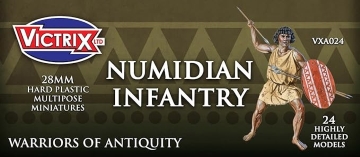
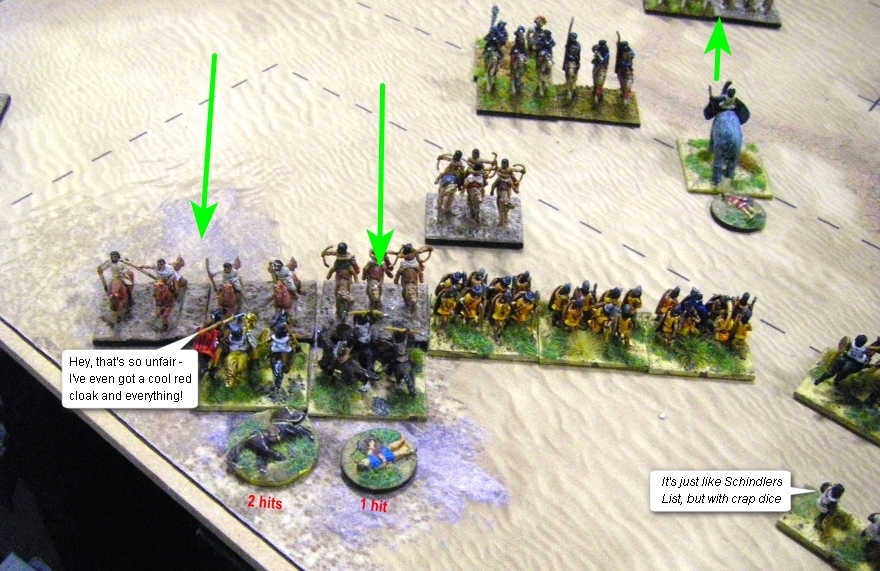
On The Left: In what was about as solid a line of anti-Camel troops as I could throw together at short notice from the detritus of a Numidian army list, the Small Command Commander included in a unit of Elite javelin-armed Medium Cavalry was almost as good as it got for anything with 4 legs, and especially so given that their place at the end of the line was one the Arabs could only manage to commit their own Light Cavalry to fighting.
Unfortunately the Numidian Commander clearly had other ideas.
Perhaps irked by the lack of plaudits for his admittedly decisive role in the previous game, he was instantly unhorsed, losing the initial combat and then suffering the ignominy of a "Risk to General" roll of "1", resulting in his loss and the loss of another hit point for the cavalry bodyguard as well.

On The Right: The so-called "plan" of winning quickly through a semi-unsupported Death Star charge against some of Rome's best troops was working out as well as one might expect too, as holes started to appear in the Numidian lines with Cavalry and Spanish Mercenary infantry both taking a tumble.
Even the Roman Archers were standing firm, in a resounding endorsement of the benefits of Ciabatta over unlevened flatbreads.

On The Left: The Numidian Elephant had however pretty much totally scared away all of the Arabian Cameleers, it's unfocussed bowling ball strategy proving too much for the minds of the desert dwelling riders who scattered like bits of sand in a sand storm (look, it is true, if not that poetic) to avoid getting trunked to death.
With many of the Camel riders now pretty much out of the game, the Imitation Legionaries found themselves with both time and space to reorganise themselves and seek out the Arabs who had bravely - or foolishly - engaged in actual combat, and quietly surround them ready to deliver a stunning rebuke to their impertinence.
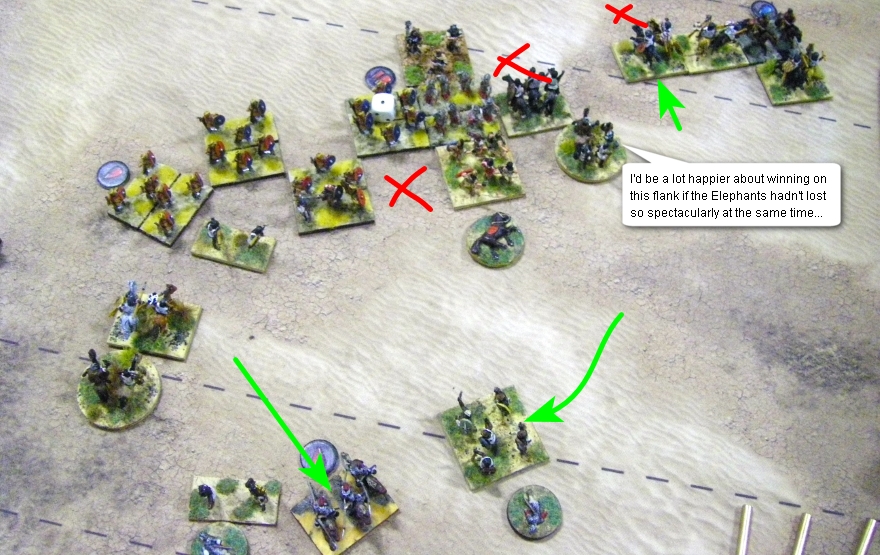
On The Right: The second elephant had not fared so well, and the Death Star had now undergone a genre-bending Full Saucer Separation as it failed to really do much to dent the line of well-drilled Auxilia.
But, things were not all bad - the Numidian Cavalry had finally come to life, defeating the overstretched Roman wing guards, who now only had a handful of troopers left, all of whom were surrounded by Numidian warriors.
Even the Roman Lancer who has expected to roll up this wing on his own was becoming increasingly lost and befuddled, as the evading Numidian troops danced around him, peppering him with javelins and always nimble-footedly evading his charges as they lured him even further away from where the crux of the battle was taking place.
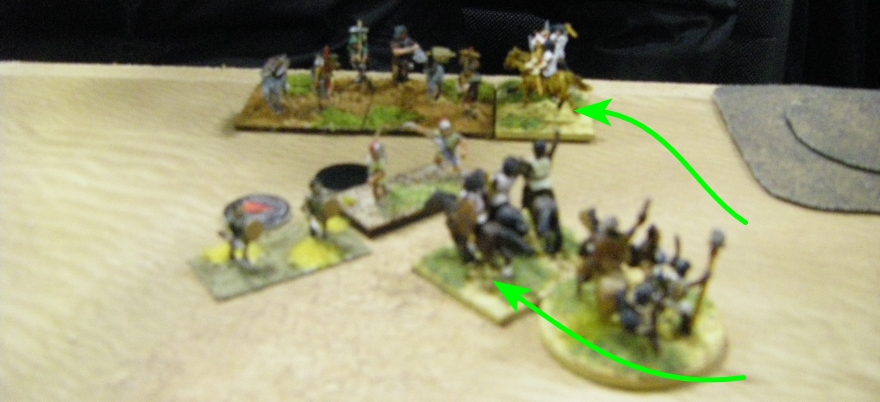
In The Centre: With the Roman left flank cavalry having been swept away the route to the Roman camp was now open for the Numidian horsemen from my right wing - and they took advantage with alacrity, steaming forward at pace to sweep in and collect the booty due to them in raiding this uncharacteristically unfortified marching un-fort.
With Numidian javelinmen now picking on, and picking off off isolated Roman troops across the desert plain, and the loss of the Roman camp undermining their morale the battle was now totally in the balance, with both sides teetering on the edge of defeat.

In The Centre: And teeter it did for a heart-in-mouth series of moments, as both armies stared defeat in the face, and grasped at the straws of victory in a form of martial contortionism the like of which is rarely seen and even more rarely described in such a clumsy manner.
But in the end the Numidian's javelin points were not quite sharp enough, their aim fell just short or the many targets presented to them in the dispersal of the army of the Eternal City, and the forces of Rome survived to eke out a victory by the narrowest of possible margins.

A defeat for Numidia, with the forces of Rome just one solitary hit point away from also breaking their army too !
Post Match Summary from the Numidian Commander
 Hear me still, riders of dust and iron, for even the desert must sometimes bow to an unseasonal wind.
Today we did not take victory by the throat; it slipped past us by the width of a breath, by the space between one heartbeat and the next. Let no man say we were broken. We were tested, and the test was cruelly written.
The Romans came as they always do: heavy with iron, slow with certainty, trusting that discipline alone can conquer the world. And against them our elephants locked tusk and trunk, turning their lines into groaning timber and red earth. More than once I saw the Roman standards waver like reeds before floodwater. Their courage cracked. Their gods looked away.
But the desert, which has always known us as its heirs, revealed a new face.
From the Roman flank came their borrowed shadow: Arabs astride camels, beasts shaped like questions the battlefield had not asked before. Where we expected open sand and obedient wind, there rose a moving wall of long necks and alien rhythm. The desert did not betray us—no, it merely reminded us that even the oldest teacher may introduce a new lesson without warning.
Against this strange tide stood our imitation legionaries, Numidians armoured in Roman fashion yet fighting with African hearts. Shield locked to shield, they held, they bled, they learned the language of the enemy and spoke it fluently in steel. They did not yield. They argued, stubbornly, with spear and short sword, and for a long moment the camels themselves hesitated.
And there fell our brother, our sub-commander, struck down amid the confusion of unfamiliar beasts and swirling dust. His death was not defeat, but it was weight—and the scales of battle are cruelly sensitive. When he fell, the moment tipped. Not because we lacked courage, but because fate chose its timing with a miser’s precision.
Know this: the Romans did not break us. They survived us.
Text analysis
A few breaths more, a single heartbeat denied to destiny, and their morale would have shattered like sun-baked clay. They felt it. I saw it. They won not by mastery, but by endurance sharpened with foreign aid.
We withdraw today not in shame, but in knowledge. The desert has shown us a new shape, and next time we will cast a longer shadow. The sand remembers every footprint, and it teaches those who endure.
Stand tall. Sharpen your spears. Mourn our fallen, but do not doubt. The sun has not finished with us yet.
Hannibal's Post Match Analysis
 Ah, defeat—now there is a tune you play with far more honesty, though still a little off-key. Come, lord of sand and selective memory, sit upon the gunwale with me and let us count your bruises like coins after a storm.
You tell me you were surprised by Arabs on camels. Surprised. You—born of dust, suckled by dunes, allegedly on first-name terms with every mirage between sunrise and sense. That is not misfortune; that is negligence dressed as astonishment. When desert men appear in a desert, the only shock should be how late they are.
Where were your spies? Asleep? Counting grains of sand? Or composing the very homilies with which you later tried to smother the truth? Alliances do not materialise like genies from jars. They walk for weeks, they bargain loudly, they leave footprints a child could read.
And do not insult history while you are at it. Only last year—last year!—your own cousin, commanding the Sassanid Persians, paraded Arab allies across half the world in battles so public they might as well have been announced by flute and banner. Camels trampled men then, too. Was this knowledge lost somewhere between your ears and your tent?
Still, let us be fair—for I am magnanimous when the wine is good.
You were not crushed. You were shaved. The battle tipped by the thinnest slice of fate, by one sub-commander who discovered too late that camels require more than polite resistance. Had he fought with a little more venom, a little less calculation, the Roman morale would have cracked like sun-baked clay and we would be drinking to their funeral.
Ah—but there we differ, you and I.I do not permit my men to fight carefully at the hinge of history. I would have filled that wavering heart with fire, fear, and fury in equal measure. Camels or no camels, my officers would have stood like hooks in flesh, not counters in a ledger.
So yes—you lost narrowly. Yes—you nearly had them. And yes, fortune winked at Rome while squinting at you.
But remember this, desert philosopher: A general surprised by camels in the sand has already been defeated—long before the first beast kneels.
Now drink - if you can still afford the price of a coffee at the Farnboro' Expo Centre. The sheer expense dulls the memory, at least until the next game
Click here for the report of the next game in this competition
Here's me, talking you through this game
You may also like....
Game 1 Numidian vs Ancient British
Game 2 Numidian vs Late Imperial Roman (Italian)
Game 3 Numidian vs Late Imperial Roman (French)
Game 4 Numidian vs Late Imperial Roman (English)
Game 5 Numidian vs Bosporan (quite near Derby)