

The Year 1106 at Devizes 2026
Christian Nubian vs Tuareg
Game 1 Christian Nubian vs Ghaznavid
Game 2 Christian Nubian vs Berber
Game 3 Christian Nubian vs Tuareg
Game 4 Christian Nubian vs Ghaznavid
Game 5 Christian Nubian vs Komnenan Byzantine
Game three unfolded beneath the slanting rays of late‑afternoon Wiltshire sunshine, the classroom glowing like a desert shrine as Nubians and Colin “Call me a helo, and I’ll be back for breakfast” Cavanagh’s Tuaregs prepared to clash.
The light caught the camel models just so, giving the whole affair a strangely majestic, slightly ridiculous aura — perfect conditions for a cameltastic showdown.
Colin, condemned to the noble but thankless role of umpire, had chosen Tuaregs as an army that would — in theory — run itself. This would free him to focus on scoring, organising draws, and generally being the administrative backbone of the event.
The Tuaregs, however, had not read the memo.
After two games they were sitting smugly on two wins, leaving Colin perched atop the leaderboard like a desert-dwelling tortoise stranded on a fence post, wondering how on earth he’d got there and how on earth he’d get down!
The Tuaregs
The Tuareg army in ADLG represents the fierce, mobile desert warriors of the central Sahara, famed for their mastery of camel warfare and their ability to strike suddenly across vast, inhospitable terrain. Historically, the Tuareg confederations dominated caravan routes, raided rival tribes, and maintained a proud warrior tradition centred around elite nobles and fast‑moving camel cavalry.
Strengths: Tuareg armies excel in mobility and shock action, built around powerful Elite Impetuous camelry capable of delivering devastating charges in open terrain. Their camel troops are resistant to enemy mounted forces, making them dangerous opponents for cavalry‑heavy armies. Supported by solid warrior infantry and nimble skirmishers, Tuaregs can rapidly concentrate force, overwhelm isolated units, and exploit gaps with speed and aggression.
Weaknesses: Their reliance on camelry makes them vulnerable in bad terrain, where their mounted troops lose punch and become clumsy. Impetuous troops can also be difficult to control, especially for an army with one of the lowest Command ratings of any army in the entire rulebook. This can easily lead to over‑extension or piecemeal attacks if not carefully managed. Their infantry, while enthusiastic, is still brittle and also hard to control, meaning it can struggle to avoid being drawn into bad situations and matchups. Narrow deployments or crowded setups can quickly exacerbate all of these weaknesses, turning their mobility and attacking prowess advantages into a chaotic camel traffic jam.
Overall, the Tuareg army thrives on open‑field manoeuvre, decisive charges, and aggressive tempo. When they dictate the pace of battle, they are fearsome; when forced into terrain or fragmented, their camel‑powered momentum can stall dramatically.
The lists for the Christian Nubian and Tuareg from this game, as well as all the other lists from the games at Devizes can be seen here in the ADLG Wiki.
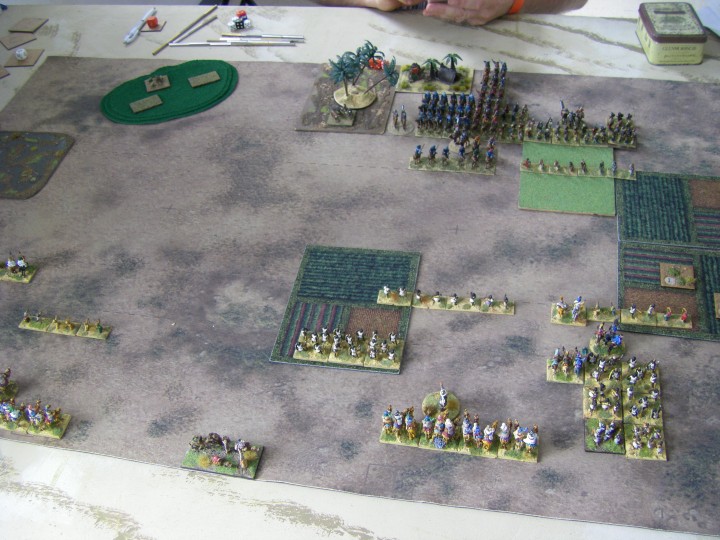
The battlefield was littered with camel‑unfriendly fields, furrows, and agricultural nonsense, forcing the Tuaregs to huddle on their left flank like nervous commuters waiting for a bus.
Opposite them, the Nubians had deployed with all the caution of a man assembling flat‑pack furniture without instructions — spread across the entire field in a haphazard sprawl.
Their infantry scurried eagerly toward any scrap of terrain that might shield them from the looming wall of Elite Tuareg camelry glaring at them with disdain.

ADLG hint - Camels in ADLG can fight in "Dunes" and "Brush" as if they were in "open" terrain, making them deadly to most infantry in these terrain types. They treat "fields" and "plantations" as Rough Going, taking sever combat penalties and losing their "Furious Charge" and "Impact" abilities - so effectively agricultural land is entirely off limits to them in-game.
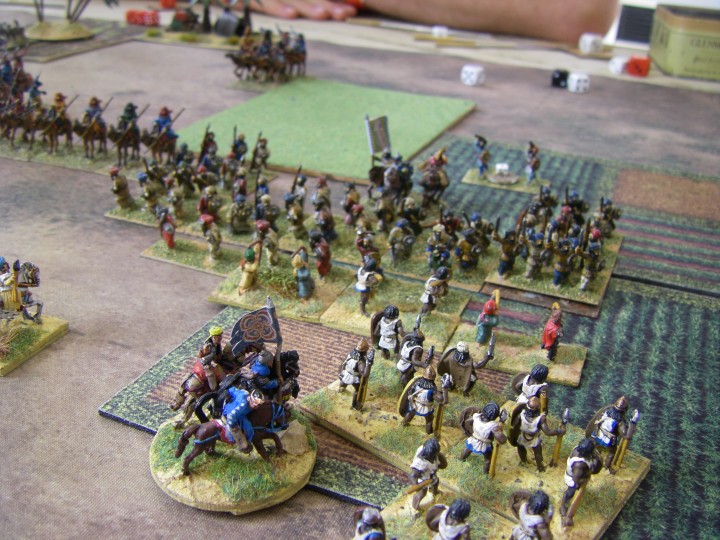
Unfortunately for the Nubians, the Tuaregs had brought more Warriors to the party.
The Christians’ tactic of sprinting for terrain was matched stride for stride by the desert dwellers, both sides hurling infantrymen into the agricultural hinterland on the right flank as if competing in some obscure rural sport involving furrows, sweat, and misplaced enthusiasm.
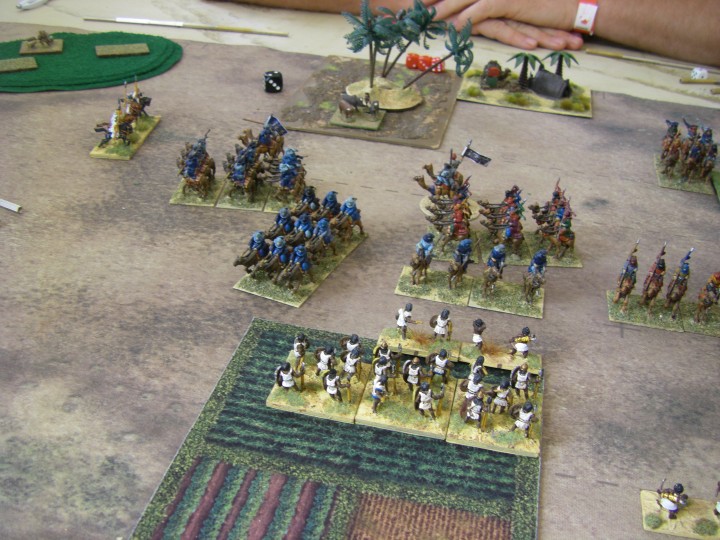
The Tuaregs soon realised that their dense deployment had created a camel‑based traffic jam — never ideal when your mounted troops are Impetuous, unmaneuverable, and possessed of the spatial awareness of a disgruntled sofa.
As they surged forward, the desert warriors were forced to split into multiple columns to escape the mess they’d created, while the Nubian infantry watched from the safety of a ploughed field with the wry amusement of men who had seen this sort of camel‑chaos before.

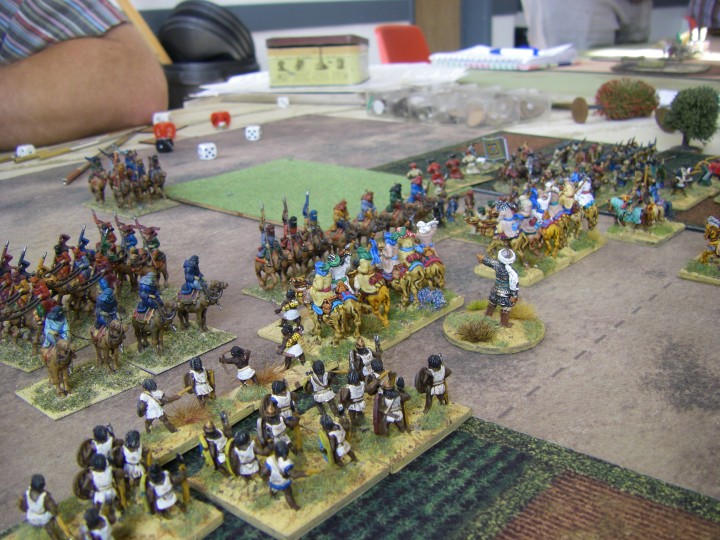
 Soon — inevitably — Nubian and Tuareg camelry found themselves face‑to‑face.
The Nubians, spotting that most of the Tuareg mounted warriors had drifted leftwards like sand blown by a lazy breeze, launched forward aggressively. Only a thin screen of Tuareg camel skirmishers remained to hold the centre, their expressions suggesting they would rather be anywhere else.
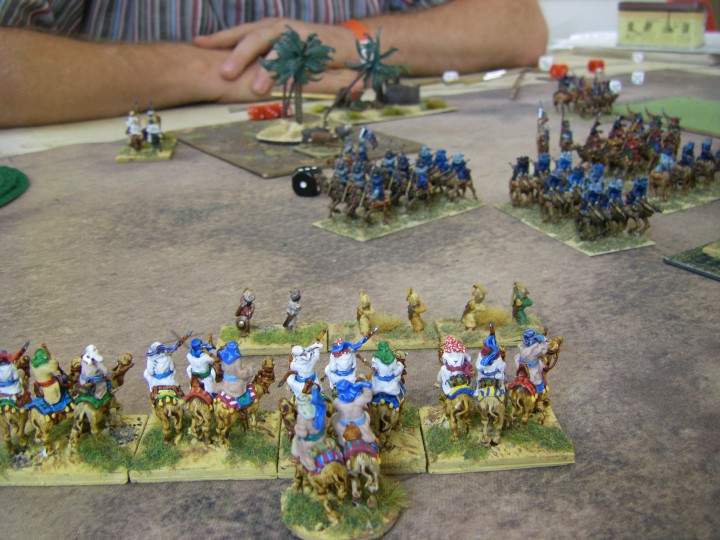
Meanwhile, the main Tuareg force marched in every direction at once, creating a spectacle reminiscent of the Edinburgh Tattoo — but with furious camels, dried‑date flatulence, and none of the reassuring discipline of kilted Guardsmen braving a stiff Highland breeze.
The Nubians’ Beja allies advanced in a calm, coherent line, utterly bemused by the swirling chaos unfolding before them.

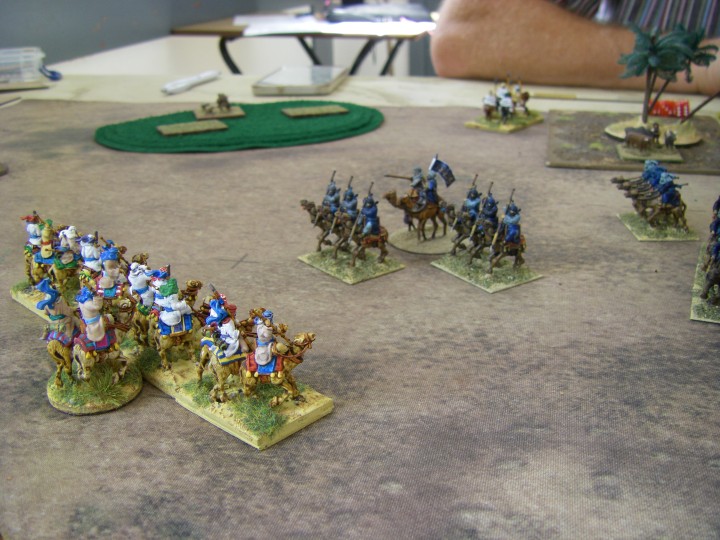
Having split themselves into far too many units, the Tuaregs soon lost control of their enraged camel warriors.
The beasts decided that now — right now — was the perfect moment to launch piecemeal attacks against the Beja, who had apparently usurped their rightful claim to the Camel Throne.
The Beja braced themselves, wondering what they had done to deserve this honour.
ADLG hint - Impetuous Camels in ADLG will charge at pretty much anything in range, unless controlled by a Commander expending a serious amount of Pips to halt them or get them to do anything else. With an army-wide command rating of only +2, this is harder to do than it sounds !
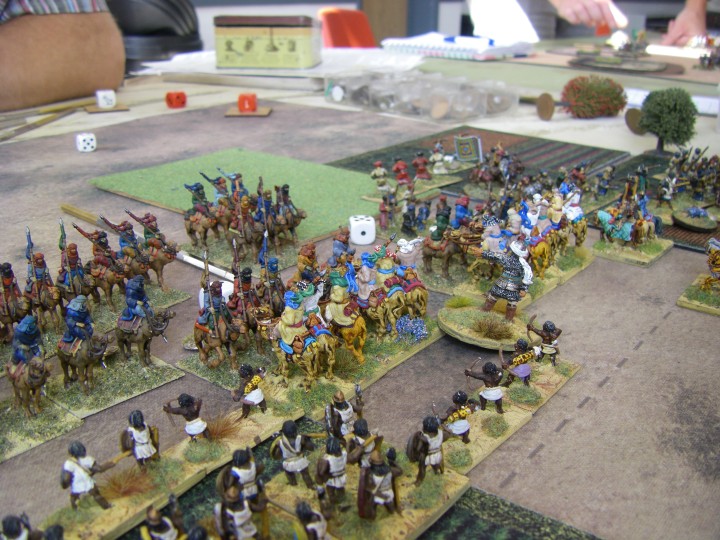
In the centre, the Nubian camelry were making steady, confident progress against the lighter Tuareg elements.
More Tuareg troops massed ominously behind the skirmishers, ready to replace them, but for now the Nubians pressed forward with the determination of men who had spotted a tactical opportunity and were absolutely going to take it.
Yes, the Tuaregs should be painted blue..!
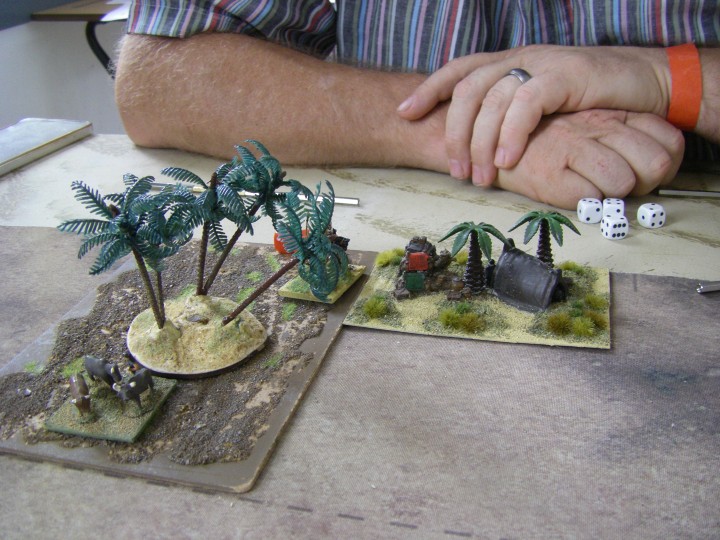
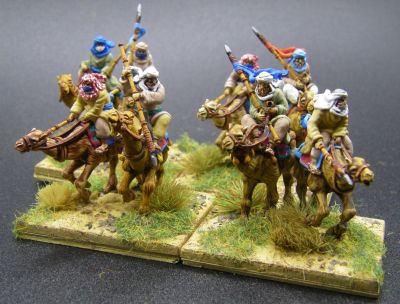 The Tuaregs’ narrow deployment had gifted the Beja so much space that they were able to send a unit of horse‑mounted lancers off on a delightful baggage‑raiding adventure.
The Bedouin horsemen slipped through an Oasis (other fruit‑based beverages are available) and gleefully looted the enemy camp, proving once again that if there is baggage to be raided, Bedouin cavalry will find it.
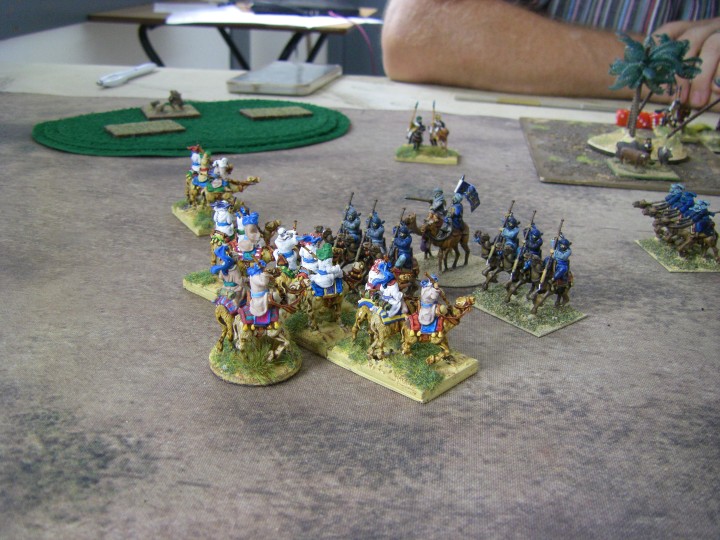
The Tuaregs, still fragmented and flustered, continued to impale themselves one by one upon the coherent, disciplined line of Beja camelry.
It was less a battle and more a slow‑motion demonstration of how not to coordinate camel‑based warfare as far off in the distance a lone date vendor looked on in disbelief, clutching his wares as if witnessing the birth of a new avant‑garde art form entitled “The Tragic Elegy of the Impetuous Camel.”
The Beja, meanwhile, maintained their formation with the serene detachment of men watching a slow‑motion car crash involving livestock and hubris, occasionally pausing to adjust their turbans and wonder if this counted as a victory or merely a random zoological incident.
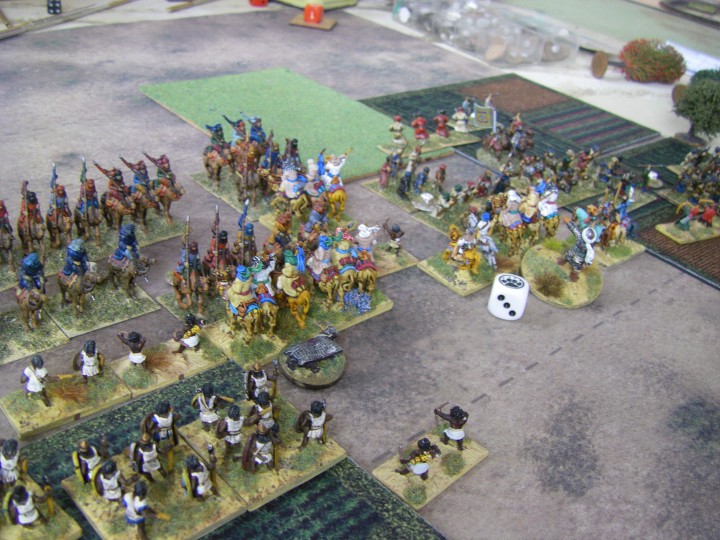
Somewhat inevitably, the Nubian camelry broke through the Tuareg skirmishers and crashed into the decidedly average Tuareg camelry behind them.
More significantly, the massed Tuareg foot had battered the Nubian infantry — but in doing so had stepped unwisely out of the protective ploughed fields and into the open.
This was all the invitation the Nubian camelry (and the occasional armoured cavalryman) needed to ride them down with gleeful enthusiasm.
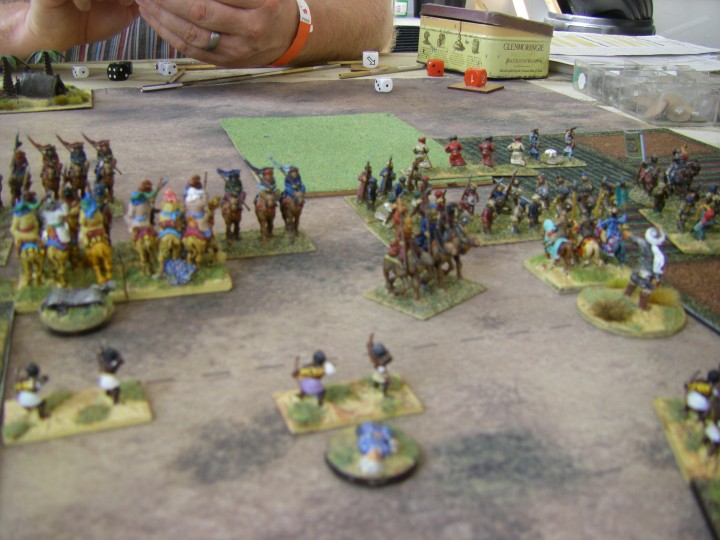
Things were not entirely rosy for the Nubians however.
The Tuareg camels, digging deep into reserves of stubborn fury, surged forward in a gargantuan effort to halt the slaughter of their infantry.
The irate Tuaregs lunched forward and punched a “Battle of the Bulge” style hole — with less snow and significantly more sand — into the Nubian lines, causing real disarray on the Nubian right flank.

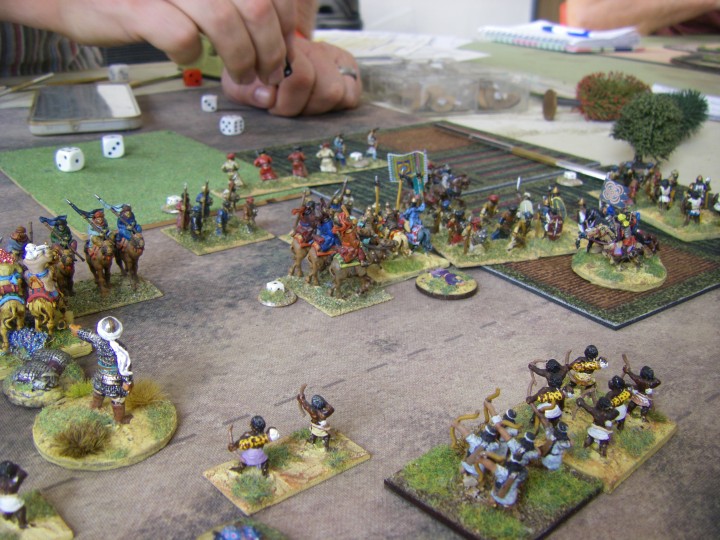
The Tuaregs finally managed to bring their numbers to bear, overwhelming the four paltry Nubian camelry on that flank, surrounding their cavalrymen, and threatening the second line of Nubian archers behind them.
For a moment, the desert winds shifted, and the battle hung in the balance.
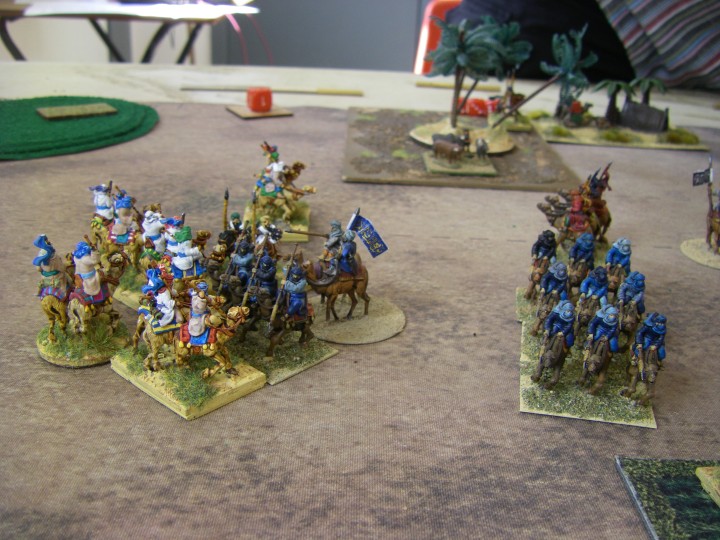
But the piecemeal destruction of the Tuaregs on the open wing, combined with the loss of their camp and the running‑down of over‑extended camel skirmishers and infantry, proved too costly.
The small but spirited Tuareg army slumped to defeat, leaving the Nubian–Beja alliance perched triumphantly atop the hump of the camel of the world as they strode confidently into the Saturday evening curry session.

The Result is a third win for the Nubians!
Click here for the report of the next game in this competition, or read on for the post match summaries from the Generals involved, as well as another episode of legendary expert analysis from Hannibal
Post Match Summary from the Christian Nubian Commander
 Warriors of Makuria! Beja brothers! Camels of uncertain loyalty! Gather close and behold the miracle that has unfolded beneath the merciless sun. The Tuaregs have fallen — not merely defeated, but artistically dismantled, as if the Lord Himself choreographed their confusion for our amusement.
Did you see them, my children? Those desert riders impaling themselves upon our righteous line like sinners upon the thorns of their own pride!
Truly, Saint Moses the Black must have whispered, “Let them gallop in circles, for confusion is the first step toward enlightenment.” And lo, enlightenment struck them squarely in the face — repeatedly, with camel hooves.
Our Beja allies stood firm, their camelry gleaming like the armour of Saint Michael himself, while I — your humble yet dazzling commander — directed the battle with the serene precision of a man personally advised by the Holy Spirit on matters of flanking manoeuvres.
When the Tuaregs charged, I merely raised my hand, and the angels sighed, “Not today.”
Let the chroniclers write that the field was transformed into a cathedral of victory, its altar a ploughed field, its incense the dust of fleeing camels. The Tuaregs prayed for deliverance, but alas, Saint Cyprian of Carthage was busy watching us win.
Even the wind joined our hymn, carrying the scent of triumph and slightly singed camel hair across the dunes.
Hannibal's Post Match Analysis
Attend, ye worshippers of future sky‑spirits and camel‑enthusiasts of dubious competence! I, Hannibal the Nasty — bane of Romans, delight of Carthage, and inventor of insults so potent they require a license — do now address the Nubian King’s pitifully short victory speech over the Tuaregs. Short, aye — for brevity is the favourite refuge of a commander who hopes no one notices how little credit he deserves.
O Nubian King, thou sanctified turnip of the desert, thou didst proclaim triumph as though thy cunning had wrought it. Yet the Tuaregs themselves contributed more to thy victory than any act of thine own. They deployed in deep columns — deep! — like a stack of amphorae waiting to be knocked over. Instead of forming a battle line, they waddled forward in narrow queues, struggling to spread out like constipated pilgrims. By Melqart’s mighty moustache, even my elephants could have out‑manoeuvred such a formation, and elephants are famously terrible at subtlety.
And what of their camp? That precious pile of tents and trinkets, left undefended like a merchant who has wandered off to buy figs. Thy cavalry raided it with ease, not because thou art clever, but because the Tuaregs apparently believed camps defend themselves through spiritual osmosis. In Carthage, we guard our camps with soldiers. In Tuareg‑land, they guard theirs with wishful thinking.
Then behold the crowning jewel of Tuareg foolishness: their foot soldiers, who had wisely taken refuge in terrain — only to rush forward out of it like excited children chasing a beetle. Out they came, abandoning safety, stepping into open ground where thy camels could run them down with all the grace of drunken furniture. And run them down thou didst — but only because the Tuaregs practically painted a sign saying, “Trample us here.”
Yet in thy victory speech, O Nubian King, thou didst gloss over all this. Thou didst speak as though thy own brilliance had engineered the triumph, as though thy peculiar future religion had blessed thee with tactical enlightenment. Nay! Thy victory was a gift — a gift wrapped in Tuareg incompetence, tied with a ribbon of camel‑mismanagement, and delivered by three generals who apparently believed that deep columns and undefended camps were fashionable this season.
Thus I, Hannibal the Nasty, proclaim: thou shouldst claim almost no credit for this victory. It was not thy strategy, nor thy faith, nor thy camel‑breath that won the day. It was the Tuaregs, who blundered, bumbled, and blithered their way into defeat with such enthusiasm that even a Carthaginian accountant could have beaten them while balancing ledgers.
Therefore, O Nubian King, thou art hereby titled: Lord of Lucky Opponents, Duke of Accidental Triumphs, and Grand Vizier of Victories Best Attributed to the Enemy’s Stupidity. May thy next battle require at least one moment of genuine skill, lest I be forced to invent yet more insults to describe thy continued reliance on foes who defeat themselves by the time you have concluded your next game
Click here for the report of the next game in this competition
You may also like....
Game 1 Christian Nubian vs Ghaznavid
Game 2 Christian Nubian vs Berber
Game 3 Christian Nubian vs Tuareg