

The Early Dark Ages at The Dorset Dodderers 2026
Justinian Byzantine vs Arab Conquest
Game 1 Justinian Byzantine vs Zapotec
Game 2 Justinian Byzantine vs Justinian Byzantine
Game 3 Justinian Byzantine vs Thematic Byzantine
Game 4 Justinian Byzantine vs Arab Conquest
Game 5 Justinian Byzantine vs Classical Indian
After an evening of rather limited debauchery and excitement, involving sit-in fish and chips and a small glass of non-alcoholic sherry the retired and part-time contingent reassenbled in the light and airy surroundings of the Entoyment Shed for the second day of ADLG action at the Dorset Dodderers.
Astonishingly, all of the oldsters had survived the night intact, bucking statistical convention and causing legions of life insurance underwriters to cry into their morning Starbucks as they trudged into workplaces overlooking the less scenic parts of Poole Harbour.
Whether the odds would shift in their favour following two more games of ADLG was however still all to play for - as was the Justinian Byzantines hopes of holding onto their empire against the onrushing desert storm that was the Arab Conquest, who they now faced under the command of Harry "In The Navy" on a fine and bright Sunday morning.
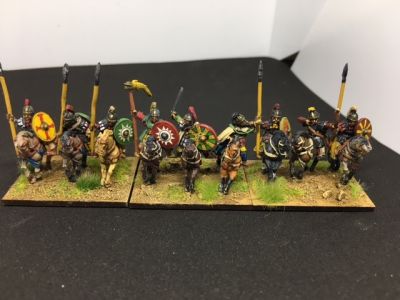
The Arab Conquest army list in L’Art de la Guerre represents the early Islamic armies of the 7th century—forces that emerged from the Arabian Peninsula and rapidly dismantled both the Sassanian Empire and much of the Eastern Roman (Byzantine) frontier. Historically these armies were highly mobile, cohesive and motivated, combining tribal cavalry traditions with disciplined infantry formations. In ADLG terms, the list captures this blend of speed, flexibility and resilient, stubborn infantry who together can deliver constant pressure, making it a challenging opponent for a more traditional, small combined-arms force such as the Justinian Byzantines.
Where the Justinian army reflects the last great flowering of the late Roman professional field army—with elite bucellarii, armoured lancers, and a carefully orchestrated mix of infantry and mounted archers—the Arab Conquest list represents something very different. Historically, the Byzantines at Yarmouk (636 CE) faced an opponent who refused to fight on Roman terms: Arab forces avoided set-piece shock engagements, used terrain and manoeuvre to disrupt Byzantine cohesion, and relied on aggressive light cavalry to harass, isolate, and exhaust heavier troops. ADLG reflects this through an army that is less about mounted hitting power and more about forcing the enemy to respond to solid, almost terrain-like formations of infantry whilst continually positioning its mounted and looser formation components for cumulative advantage.
Several elements of the Arab Conquest list can prove particularly troublesome for a Justinian force:
- Javelin-armed Light Cavalry — Arab armies often field numerous light horse with bows or javelins. These units can outmatch some of the Justinians light cavalry, who usually exist to protect the flanks of the core Byzantine horsemen - but unless countererd, they can then pick apart the Byzantines and tempt them into unfavourable charges. Historically, Arab cavalry excelled at fluid, swirling engagements that prevented the Byzantines from bringing their own elite lancers to bear.
- Resilient Medium and heavy Foot — Early Islamic infantry, often fighting in tight, disciplined formations, could hold ground effectively. In ADLG, the heavy foot are solid and tough to grind down, and the medium foot can exploit rough terrain — something Justinian armies dislike, as their strength lies in cavalry manoeuvre and coordinated charges on open ground.
- High Mobility and Command Efficiency — Arab Conquest lists often include a Strategist, other competent generals and a high proportion of mobile troops along with the anvil-like foot units. This allows them to dictate the pace of the battle, refuse engagements, or concentrate force suddenly. Historically, commanders like Khalid ibn al-Walid used rapid redeployment and feigned withdrawals to unbalance Byzantine formations.
- Shooting Pressure — While not a pure shooting army the Arabs have decent numbers of archers available who they can protect with their own infantry, allowing the army to apply persistent ranged harassment. Against Justinian cavalry — who rely on maintaining cohesion before delivering a decisive charge — this chip damage can be decisive.
The result is a stylistic clash. The Justinian army wants to shape the battlefield, soften targets with mounted archery, and then deliver a hammer blow with elite cavalry. The Arab Conquest army wants to prevent exactly that — stretching the Byzantine line, pulling units out of position, and forcing the elite lancers to either chase shadows or charge into the absorbent sponge of the Arab infantry. Historically, this mirrors the transformation of warfare in the Near East: the old Roman model of disciplined heavy troops supported by structured combined arms was increasingly challenged by a combination of lighter, faster, more flexible opponents with dangerouosly ferocious and stubborn infantry who attempt to fight on their own terms.
In short, the Arab Conquest list is dangerous for Justinian Byzantines not because it outclasses them in raw quality, but because it undermines their strengths. It is an army that rewards patience, mobility, and positional play — qualities that historically reshaped the balance of power in the eastern Mediterranean, and which in ADLG can make it a formidable and frustrating opponent for the heirs of Belisarius.
The lists for the Justinian Byzantine and Arab Conquest from this game, as well as all the other lists from the games at The Dorset Dodderers can be seen here in the L'Art de la Guerre Wiki.
Having won the initiative I really didn't want to be attempting to defend against what could potentially be a wall of onrushing heavy infantry, and so after some dithering I opted to attack into the deserts of Arabia - potentially a mistake on a par with the near-legendary "attack in mountains to try and get open terrain" debacle from Burton Doubles only a few weeks earlier. This time however I would be unable to blame Dave from the Podcast if it went wrong.
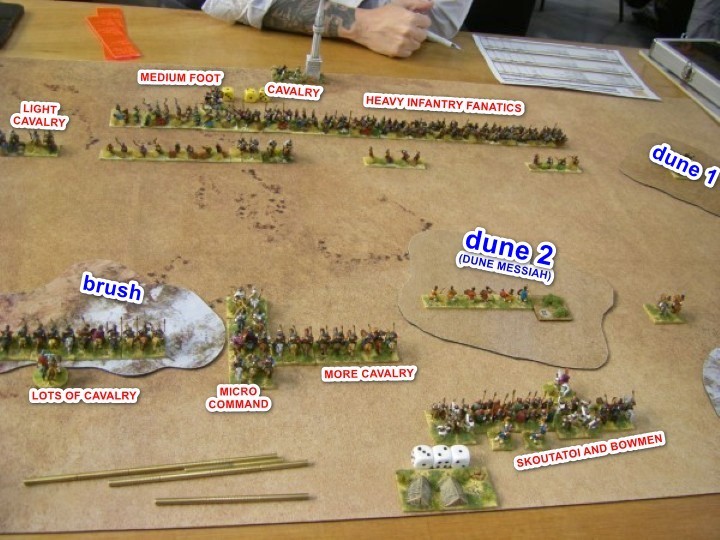
Attacking into desert inevitably meant the appearance of some sand dunes - although as the Arab Conquest is rather lacking in camelry I had hoped that Harry would not drop too many of them on table, as they would be less than ideal terrain for his close formation foot as well as my cavalry.
As it turned out they fell mostly on my side of the board, leaving vague open spaces on the Arab side - so if the Byzantine cavalry could get a good first move in they could perhaps be past the cloying dunescape and whirling around in the open plains beyond before the Arabs had even made a single step?
L'Art de la Guerre hint - The Arab Conquest army only has "Desert" as a terrain pick - so anyone attacking must do so into "Desert". This is usually regarded as being a stupid thing to do, and when combined with the Arabs reasonably high aggression (with a near-inevitable Strategist as well) and their penchant for attacking, means it is entirely possible that many Arab Conquest armies have never even had to think about what defending in Desert terrain actually entails.
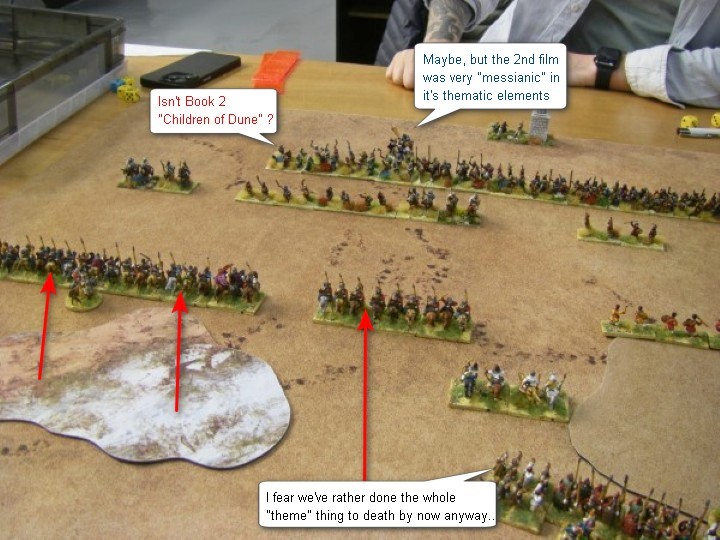
And Lo! It came to pass that indeed did happen, with a rapid advance which saw the rapire-like Byzantine cavalry contingent stacked on one flank of the table as if deployed by teleportation.
The Arab heavy infantry looked on in some disgust as the Byzantines clearly had no intention of fighting them - leaving the dune-flavoured pedestrians with the prospect of a long dusty march across the desert sands if they were ever to see a real opponent
But the disgust of the Arab foot was greatly exceeded by the panic that set in among the Arab cavalry and loose formation spearmen, who, gathered in one command on the Arab right, now found themselves the target of what looked like all of the good bits from the entire Byzantine army!

Little Known Facts About The Justinian Byzantines
Historians rarely mention the brief but catastrophic Byzantine attempt to import war llamas from “the mysterious western ocean.” Court scholars confidently predicted the animals would terrify Persian horses, though surviving records suggest the llamas mainly spat at officers and refused to cross bridges.
One frustrated general described the creatures as “strategically disappointing,” while another requested permission to exchange the entire herd for additional Hunnic mercenaries and a decent cook.
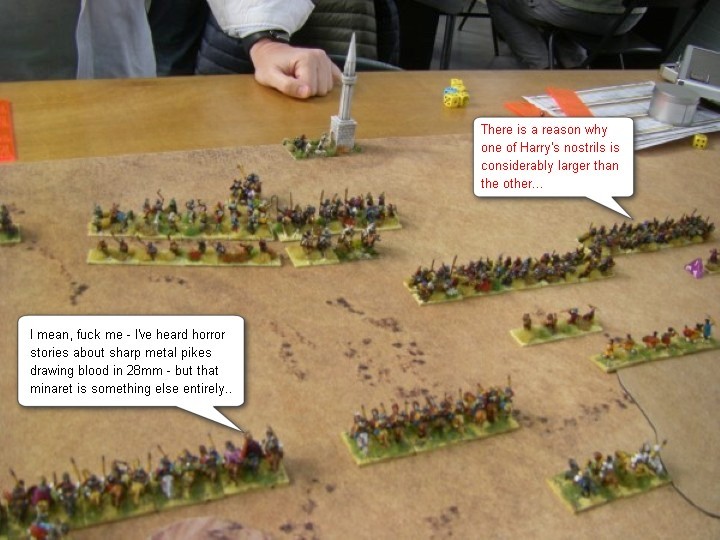
 The Arabs quickly withdrew their embattled skirmish screen and started as best they could to try and shift their vulnerable right wing to the centre, and replace them with stodgy resilient foot warriors.
This was a tricky feat to attempt, made even more so by the spear-like sharpened tip of a this seemed a good idea at the time huge minaret which constantly threatened to impale Harry every time he reached out to reposition a base of his I can't believe this army isn't 3d printed FiB metal arab figures.
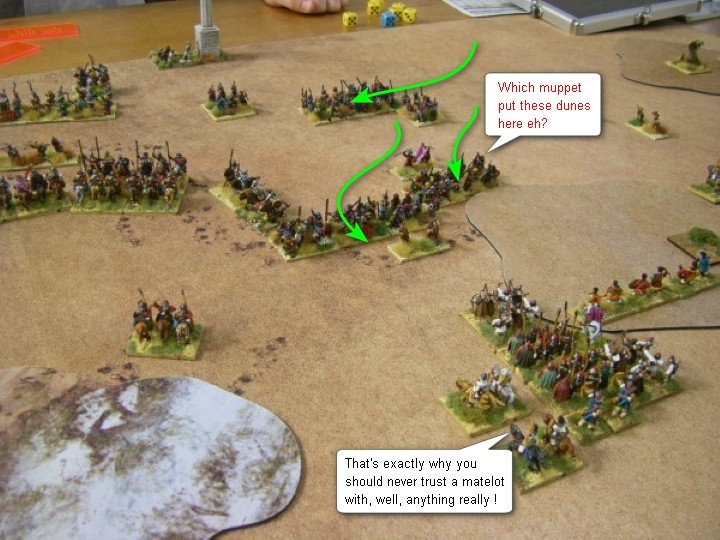
The battle soon developed into an attempt by both players to fit ADLG sized armies onto a DBA-sized corner of the board, with everyone jamming everything into a maelstrom of near-identically based carnage
The challenge for the Byzantines was clear - get around the right flank of the Arabs, but avoid becoming over-extended in the process and exposing their own right flank to a counterattack.
Unfortunately the solution to this conundrum appeared to involve pushing forward the Mediocre Skoutatoi and archers to distract the attention of some of the ravening hordes of Arabian infantry - but as long as they never actually got to fight I was sure it would all be fine...

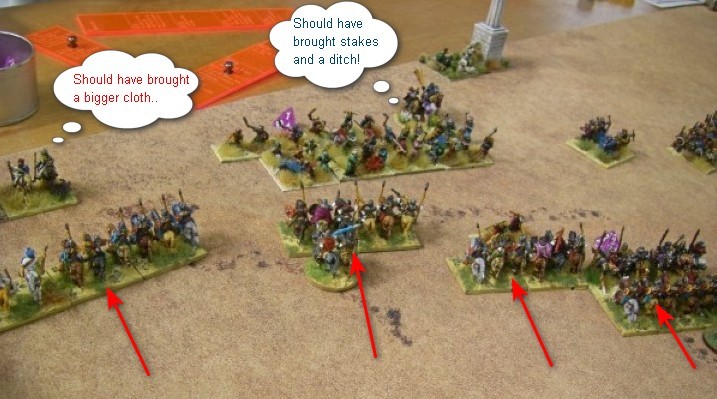
As the Byzantines continued to push forward, the Arabs started to run out of table - losing light horse off the back edge in damage-limiting evades, but in the process revealing the quivering medium foot who were clearly not quite as adept as escaping as their horse-riding colleagues.
Little Known Facts About The Justinian Byzantines
Justinian’s armies were among the first in history to encounter the dangers of bureaucratic overmanagement after officials in Constantinople introduced colour-coded supply requisition forms. Entire offensives stalled while quartermasters argued whether dried fish counted as “naval provisions” or “morale equipment.”
One furious frontier commander reportedly sent a message to the capital reading simply: “THE PERSIANS ARE HERE. PLEASE ADVISE WHICH INK COLOUR IS APPROPRIATE.”

As the Byzantine cavalry continued their painstaking (and, if you were an Arab infantryman guarding the baggage camps, painful) annexation of the Arabs right flank, their Skoutatoi suddenly realised that being nominated to act as "bait" for a horde of jihadizing warrior infantrymen may indeed also mean actually having to fight them as well.
Shaking their columnar marching formation out into a vaguely coherent line they readied their spears and bemoaned the subtleties of the Rear Support rules as they awaited their own little decisive clash.
L'Art de la Guerre hint - Having "Rear Support" (a rear rank of archers, but not enough to count as a proper shooting unit) gives a +1 in the first round of combat if the unit loses the fight. Having Rear Support also means that the extra hit which would normally be caused by any enemy with the Furious Charge effect winning in the first round does not happen.... but only if the opponent is mounted. Which is unfortunate if you are a Skoutatoi facing Impetuous Infantry - and even more so if you didn't realise this subtle wrinkle in the Rear Support rule until it's too late.
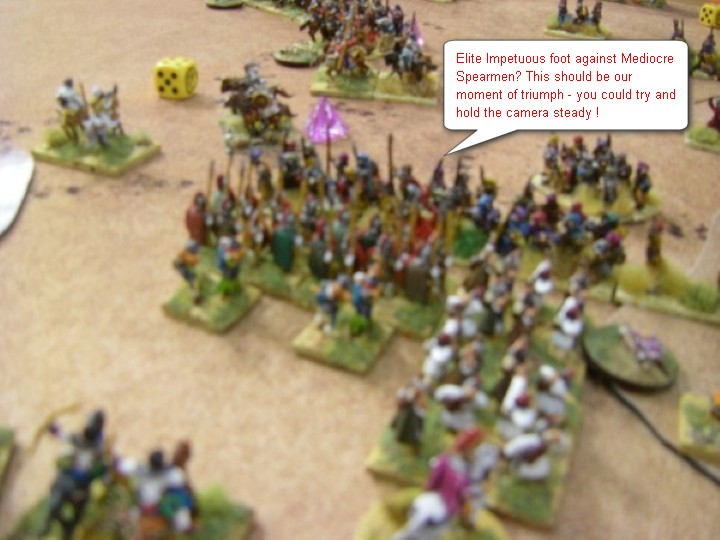
The Arabian infantry charged home furiously against the Skoutatoi, no doubt keen to demnonstrate to Harry that they were brave worthy and noble warriors, and they really, really didn't deserve to be consigned to eBay and replaced by Red Copper 3D prints soon after this event was over, no siree, absolutely not!
The early Arab Conquests
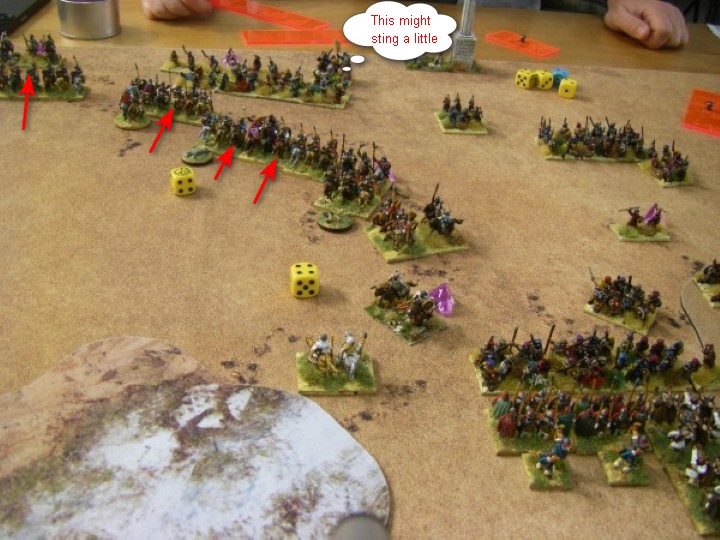
By now the broad arc of the battle was shaping up and becoming clear, as the Byzantine plan was steadily being implemented.
A near-solid line of Justinian cavalry now began to squeeze the remaining Arabs on the left against the walls of the baggage town, eagerly eyeing up the possibility of taking a minaret or two with them back to Constantinople, perhaps with half an eye to seeing if they might make an intriguing architectural addition to the Hagia Sophia somewhat ahead of the time many historians believe such features were added?
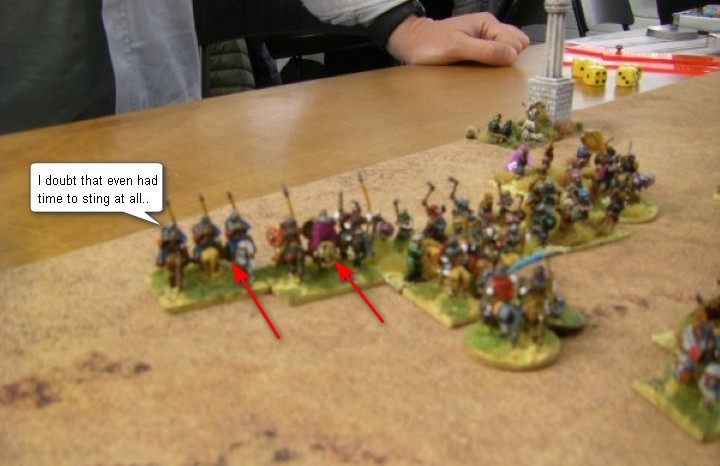
The Arabian loose formation foot were no match for Justinians elite lancers, who smashed through the line of least resistance and found themselves with almost too many targets to consider.
Little Known Facts About The Justinian Byzantines
Emperor Justinian briefly experimented with a military reform known as the Theme Park System, in which frontier troops were rewarded not with land, but with heavily discounted admission to chariot races and complimentary honey cakes. The system collapsed after several generals discovered they could simply declare their own birthdays to be public holidays and spend entire campaigning seasons in Antioch watching reenactments of victories they had not yet achieved.
Belisarius reportedly insisted his elite Bukellarii cavalry wear mirrored sunglasses during desert operations in North Africa, claiming the reflected glare would intimidate the Vandals. While modern historians dismiss this as impossible, contemporary chroniclers do note that several enemy warriors were “unable to look directly upon the Romans without squinting angrily.”
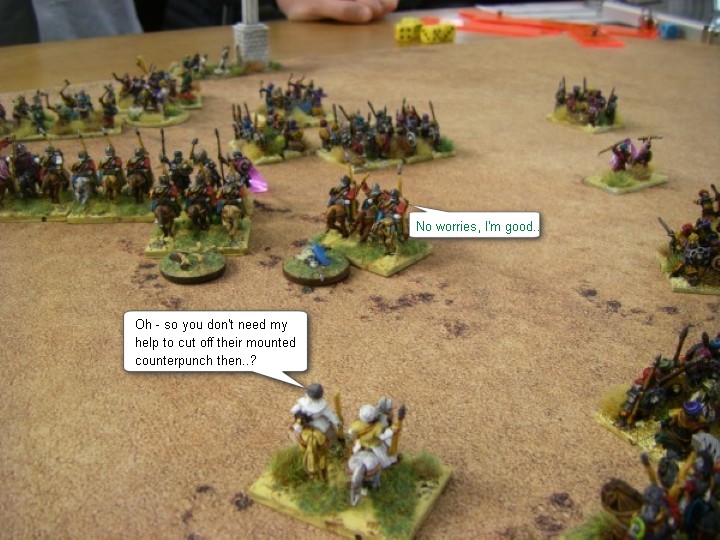
Miraculously the Skoutatoi were holding steady - or indeed, actually winning decisively - against the Arab warriors, and in the process no doubt sealing their fate as items to be posted to the highest bidder in the coming weeks.
The Byzanines cavalry had also removed pretty much every Arabian horseman from the playing surface, opening up avenues to surround and assault the only-now ariving remaining Arab infantrymen
The loyal foot soldiers of the Prophet had endured a long dusty trudge from the opposite flank only to now find they were almost the only coherent troops left in an army whos other troops were even now slowly and methodically being denuded of religious zeal.
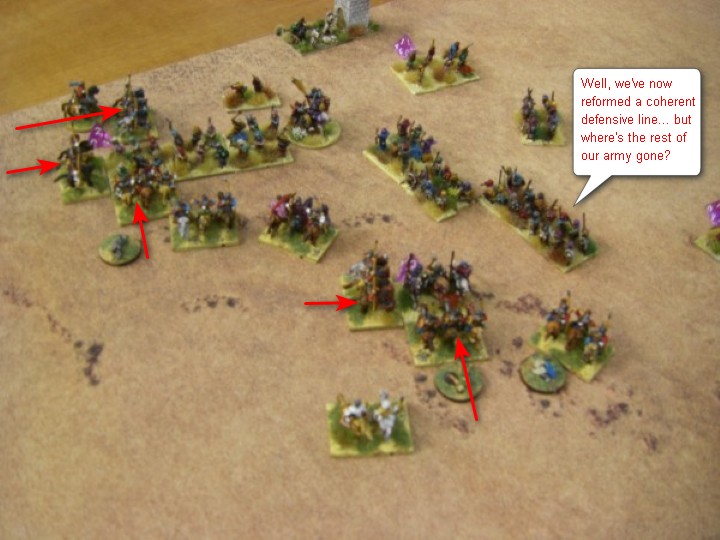
The Arabs were almost entirely wiped out on this flank, and it seemed the only question would be whether the camp would be taken before the cumulative loss of infantry, horse and skirmishers tipped the Arabs to defeat and the Byzantines to victory.
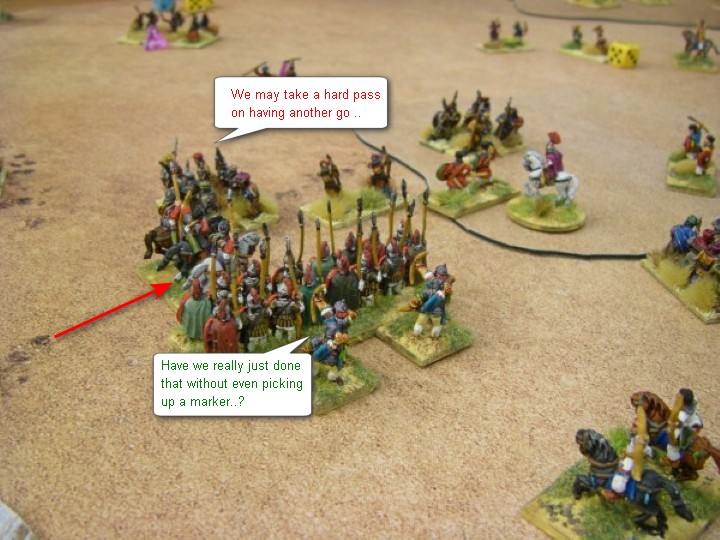
Adding insult (and death) to an already shameful litany of injuries, the Skoutatoi gleefully contributed more than their fair share to that outcome by clearing out a block of aggressive Arabians.
The surfeit of Byzantine horsemen on this side of the table had helped, but if you were to read the regimental histories of the Skoutatoi in later centuries no doubt you would find that the contribution of the riders had ended up being but a mere footnote in the Skoutatoi's glorious mediocre spear-pointed history

Little Known Facts About The Justinian Byzantines
Historians rarely mention the brief but catastrophic Byzantine attempt to import war llamas from “the mysterious western ocean.” Court scholars confidently predicted the animals would terrify Persian horses, though surviving records suggest the llamas mainly spat at officers and refused to cross bridges.
One frustrated general described the creatures as “strategically disappointing,” while another requested permission to exchange the entire herd for additional Hunnic mercenaries and a decent cook.
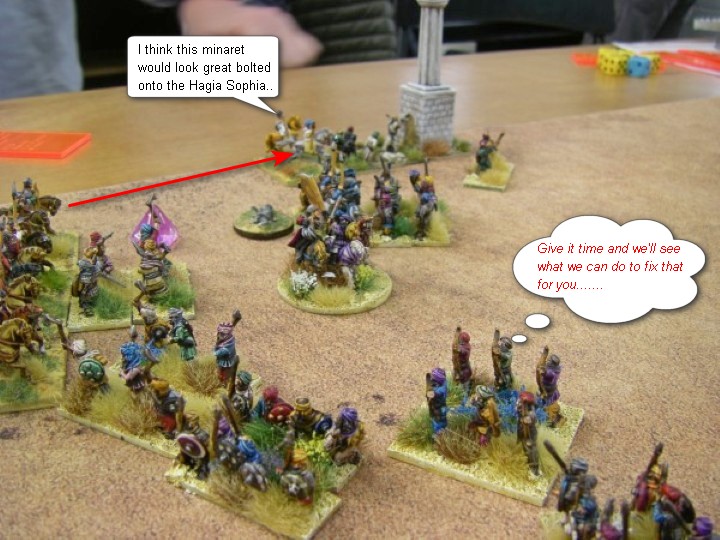
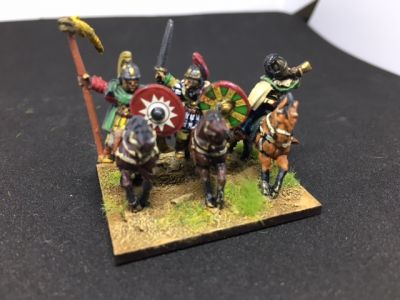 Finally, in a touch of poigniancy, the Byzantine's own Arab mercenaries gleefully stabbed their compatriots in the back and took control of the Arabian camp to claim the decisive breakthrough and win the game.
A surgical and measured display of Byzantine military drill, coupled with a mind-bendingly random decision to attack the Arab Conquest-a-dors in their home desert had done for the army of the Prophet (PBUH), and given a 3rd victory of the not-really-a-weekend to the Justinians!
The Result is a big win for the Byzantines
Click here for the report of the next game in this competition, or read on for the post match summaries from the Generals involved, as well as another episode of legendary expert analysis from Hannibal
Post Match Summary from Justinian Bieber, the Byzantine Commander
 Soldiers of New Byzantium, children of the Eagle, hear now the truth of this glorious day! For generations men said the deserts belonged to the Arabs alone. They said no Roman army could march into the burning sands and prevail. They said the sun itself would fight for them. Well, I looked upon those endless dunes and said simply: ‘Never Say Never.’ And behold! Where timid strategoi saw only heat and thirst, Justinian Bieber saw opportunity. The enemy waited for us behind wells and rocks like sulking poets, expecting us to stumble into their traps. But I, in my genius, carried the war into their desert first. We struck boldly, magnificently, and — if I may say so — with the sort of brilliance one usually only finds in my own reflection.
Observe how perfectly my cavalry performed the manoeuvre I personally devised while listening to court musicians in the gardens of the Sacred Palace. The Arab infantry came forward in their usual endless trudging masses, confident their fanatics and camel-riders would grind us down. But our horsemen did not meet strength with strength. No! That is the thinking of lesser Emperors — perhaps even of those dreary Thematic barbarians I defeated before. Instead, my cataphracts swept suddenly upon the enemy right flank with elegance and discipline, concentrating their fury like a thunderbolt hurled by God Himself. Before the Arabs could react, their flank collapsed into confusion. Their centre found itself stranded, abandoned, and wandering helplessly through the sand like tourists searching for the wrong music festival. The enemy commanders could only ask themselves one question: ‘What Do You Mean?’”
And now we speak of the impossible deed — the act future generations shall refuse to believe. The Skoutatoi garrison infantry, whom the enemy mocked as mere wall-guards and bureaucrats with spears, stood firm against the charging jihadi warriors. Those ravening zealots hurled themselves forward screaming curses and prophecies, certain they would shatter our lines through fury alone. Yet the Skoutatoi locked shields, lowered spears, and met them head-on. Head-on! Like heroes from Homer! Like tax officials possessed by Ares Himself! The Arab champions broke upon them as waves break upon harbour walls. I saw one Skoutatos strike down three warriors while calmly adjusting his helmet plume. Another reportedly killed an enemy standard bearer while asking for additional payroll forms. Such courage was so astonishing that even I briefly considered sharing some credit for the victory — though naturally I recovered from that momentary weakness.
Let all nations understand what has happened here today. The Arabs believed themselves unstoppable. They thought their conquests would continue forever, sweeping across the world like some dreadful travelling poetry recital. But today they discovered the terrible truth: there remains one power greater than fanaticism, greater than destiny, and certainly greater than competent military planning. That power is Justinian Bieber. Under my rule, Rome does not merely survive — My New Rome reinvents itself. My New Rome adapts. My New Rome swaggers magnificently into the desert wearing polished armour and impossible confidence. And when my beloved Empress Hailey looked upon me before the battle and asked if victory was assured, I simply smiled and replied: ‘Is It Too Late Now To Say Sorry?’ For I already knew the Arabs would soon be the ones apologising.
So celebrate tonight, mighty soldiers! Sing songs beside the campfires! Let the desert winds carry news of this triumph to every corner of the earth! And should future historians ask how this impossible victory was achieved, tell them this: while lesser rulers studied maps, Justinian Bieber studied greatness itself. The enemy brought numbers, fury, and faith. I brought cavalry, discipline, genius… and admittedly spectacular hair. Truly, my friends — ‘Baby, Baby, Baby, oh’… this Empire still has it.
Hannibal's Post Match Analysis
 “At last we come to Justinian Bieber’s celebrated victory over the Arab Conquest army — the battle he describes as a masterpiece of discipline, precision, and operational brilliance. And yes, certainly, he won. Efficiently, even. Neatly. One might almost say… professionally. Which is precisely the problem. The man speaks of this engagement as though he were presenting taxation records to the Senate. Where was the fury? The daring? The theatrical audacity by which history remembers truly great captains? Caesar crossed rivers in storms. Alexander charged into impossible odds. I marched elephants over mountains. Bieber, meanwhile, congratulates himself for conducting what was essentially a very competent administrative procedure.”
“Do not misunderstand me — there is skill here. His cavalry concentration against the Arab right was sensible enough. The enemy flank collapsed, their infantry became isolated, and the Byzantine line maintained cohesion throughout. Fine. Excellent. Splendid paperwork. But greatness in war is not measured solely by efficiency. Had the gods intended history to worship tidy battlefield management, accountants would have statues in every forum.”
“And what, pray, was the enemy doing during all this supposedly dazzling manoeuvre warfare? Why, the slowest infantry in the entire Arab army were calmly marching almost the full width of the battlefield to attack the Skoutatoi. Think carefully upon this. The SLOWEST troops. Not cavalry. Not camel riders. Not elite guards. Infantry. Men on foot, burdened with shields and equipment, trudging steadily across open ground under the burning sun. And apparently Justinian Bieber observed this migration with all the urgency of a man watching gardeners rearrange hedges.”
“I ask you: what sort of commander seeking immortal glory allows this to occur? If your grand decisive battle plan still leaves sufficient spare time for enemy infantry to embark upon a scenic walking tour of the battlefield, perhaps the operation lacks a certain… intensity. Hannibal Barca did not annihilate Roman armies by permitting their slowest formations leisurely opportunities for exploration.”
“Indeed, Bieber now praises the heroic stand of the Skoutatoi as evidence of Roman courage. Very stirring. Very noble. Yet one suspects the Skoutatoi themselves might have preferred slightly less opportunity to demonstrate said courage. They were, after all, the weakest troops in the army — garrison infantry better suited to walls and gates than apocalyptic close combat against ravening jihadi fanatics. And why were they placed in such danger? Because their Emperor was apparently too relaxed to interrupt the enemy infantry’s continental stroll across the battlefield.”
“Observe the contradiction in Bieber’s own account. He boasts endlessly of speed, concentration, and decisive operational tempo. Yet simultaneously the battle unfolds slowly enough for entire Arab formations to relocate themselves at walking pace before meaningful intervention occurs. Which is it, troubadour Caesar? Were you conducting lightning warfare, or hosting a guided military exhibition?”
“The entire engagement possesses the flavour of an Emperor overly pleased with his own calmness. One can almost picture him atop a hill, watching events unfold while smoothing his hair and murmuring compliments to himself about his composure. There are moments in battle demanding violence so sudden and overwhelming that the enemy loses the ability to think. Bieber instead delivered a victory resembling a carefully moderated symposium.”
“And this, ultimately, is why I cannot place the battle among the truly immortal victories of history. Effective? Certainly. Intelligent? Often. Memorable? Hardly. Future generations do not sit breathless around campfires hearing tales of ‘that time Justinian Bieber maintained admirable battlefield control while permitting gradual infantry redeployment.’ Great captains leave behind legends soaked in terror and astonishment. Bieber leaves behind tactical memoranda.”
“Even his cavalry pursuit lacked proper savagery. Once the Arab flank broke, he pressed them firmly enough, yes — but where was the merciless annihilation? Where the pitiless exploitation? He fights as though concerned future historians might accuse him of being impolite. One begins to suspect his true dream was never conquest, but favourable reviews from military academics.”
“So let the record show: Justinian Bieber defeated the Arab Conquest army competently, responsibly, and with admirable restraint. Which is to say he won the battle in almost the least inspiring manner imaginable. History remembers conquerors, gamblers, maniacs, and visionaries. It rarely remembers men whose greatest achievement was ensuring everything remained broadly under control - and in fact,, even though it is yet to occur, I fear I may have already forgotten the next game too!
Click here for the report of the next game in this competition
You may also like....
Game 1 Justinian Byzantine vs Zapotec
Game 2 Justinian Byzantine vs Justinian Byzantine
Game 3 Justinian Byzantine vs Thematic Byzantine