


The Early Dark Ages at The Dorset Dodderers 2026
Justinian Byzantine vs Classical Indian
Game 1 Justinian Byzantine vs Zapotec
Game 2 Justinian Byzantine vs Justinian Byzantine
Game 3 Justinian Byzantine vs Thematic Byzantine
Game 4 Justinian Byzantine vs Arab Conquest
Game 5 Justinian Byzantine vs Classical Indian
The final game at the 2026 Dorset Dodderers, and I'd already managed to crumble in my resolve not to buy any more figures in Entoyment's shop, as the opportunity to pick up some more FiB packs with the full 24 infantry rather than their newer 16's had proved just too great. Even so, managing to resist any more plastics was an upside, as was to be going into the final round with a decent stab at placing, against Mr Perry's (no, not that one - nor his brother) Classical Indians.
The Classical Indian army in L’Art de la Guerre is one of the most distinctive forces in the system, combining ponderous but terrifying elephants, dense blocks of mixed bow‑and‑sword infantry, and—depending on the variant—elite Rajput‑style lancers who give the list a surprising offensive edge. Historically, this reflects the military traditions of northern India from the Gupta period through the early Rajput states: armies built around elephant corps and massed archery, with noble cavalry providing shock capability. On the table, this creates a force that is slow to redeploy but extremely dangerous once its battle line is established.
For a Justinian Byzantine army—whose strengths lie in manoeuvre, elite heavy cavalry, and combined arms—the Classical Indians present a very different challenge from the frontally tough infantry and mobile cavalry of the Arab Conquest. Historically, the Byzantines never fought Indian armies, but the contrast mirrors the difficulties late Roman armies faced when confronting opponents with powerful war beasts or dense infantry formations that resisted cavalry charges. In ADLG terms, the Indians’ elephants and massed shooters can neutralise the Byzantines’ best tools if the Byzantines allow themselves to be pinned into a frontal fight.
The Classical Indian list causes problems for Justinian forces in several key ways:
- Elephants — The single biggest threat. Elephants devastate cavalry on impact, ignore most shooting, and create zones the Byzantines cannot safely enter. A Justinian army that relies on elite lancer charges finds its best units effectively shut out of large parts of the battlefield.
- Mixed Bow/Sword Infantry — These units provide steady shooting and can hold ground well. They are not elite, but they are numerous, and they blunt cavalry charges while supporting the elephants. Historically, Indian archers were famed for volume of fire, and ADLG reflects this with persistent ranged pressure.
- Elite Rajput‑style Lancers — This variant gives the Indians a mobile striking arm. These lancers can threaten Byzantine horse archers, counter‑charge weakened bucellarii, or exploit gaps created by elephants. Their presence prevents the Byzantines from simply dominating the flanks.
- Sheer Width and Mass — Classical Indian armies often field many medium foot and elephants, creating a broad, slow, but extremely solid line. Once deployed, it is difficult for the Byzantines to break through quickly.
The traditional counter—both historically for armies facing elephant corps and in ADLG—is to avoid fighting the Indian army on its terms. The Byzantines want open terrain, space to manoeuvre, and the ability to concentrate force on one flank. If they can overwhelm a wing before the Indian centre can wheel its elephants around, they can collapse the line from the side. This mirrors the historical Roman approach against Pyrrhus and later eastern armies: avoid the elephants head‑on, stretch the enemy, and strike where the beasts cannot intervene.
The Indians’ great weakness is their lack of lateral mobility. Elephants cannot redeploy quickly, and mixed infantry are slow to turn. If the Byzantines can force a refused flank, create a local 2‑to‑1, and hit hard before the Indian line pivots, they can win decisively. But if they misjudge timing or terrain, the Justinian army risks being pinned, shot, and crushed by the very units it hoped to avoid.
The lists for the Justinian Byzantine and Classical Indian from this game, as well as all the other lists from the games at The Dorset Dodderers can be seen here in the L'Art de la Guerre Wiki.
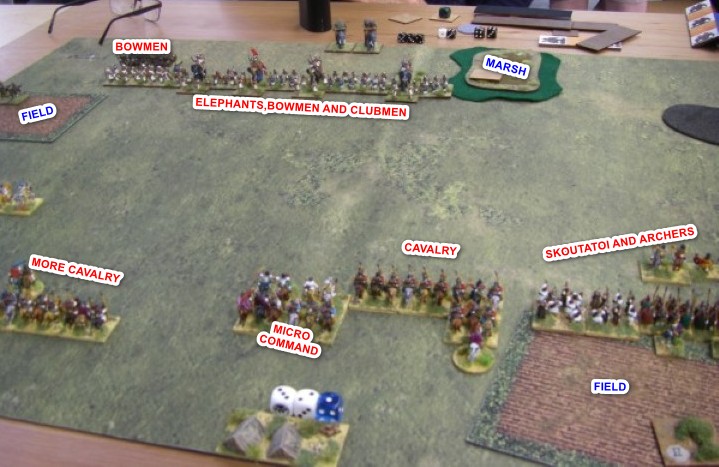
With Kevin clearly channelling his inner Patrick Swayze, he had chosen to put his own Indian army very much in a corner, anchoring it on a marsh and a field.
I had rather been hoping he'd just string the whole lot across the table in an unthinking and unimaginative fashion, so this deployment came as something of a downer, with the prospect of having to think about things in the 5th game of the non-weekend suddenly looming large.

The inconvenient factlet that this Indian army had already won its' previous 4 games, mostly against Byzantines, also seemed likely to be a fly in any ointment the Byzantine troops may have previously bought in the Grand Bazaar of Constantinople - but, hey-ho, that's life I guess!
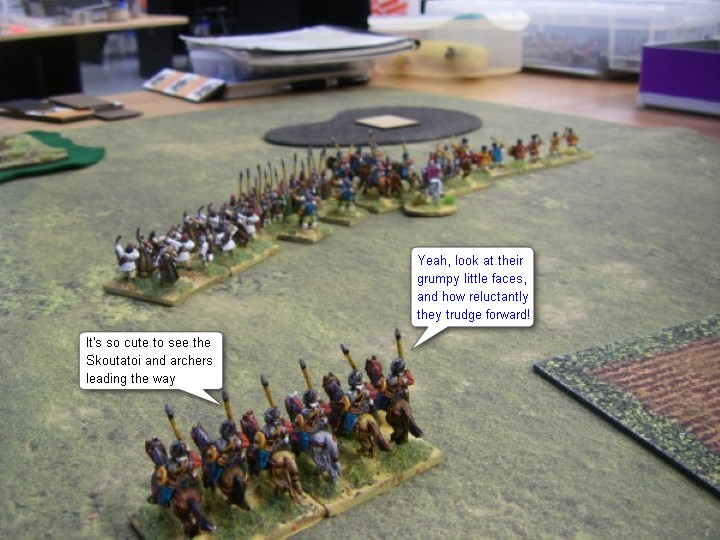
The Skoutatoi and archers found themselves with no opponents as the compact deployment of the Indians failed to cover the entire field.
Realising that sitting and reading a book was not an option the Byzantine high command would sanction, the infantrymen began an unwilling trudge across the table, wheeling towards the left hand end of the Indian line on a mission to see if peppering them with arrows and cod-Latin taunts could tease them out of their defensive bastion.
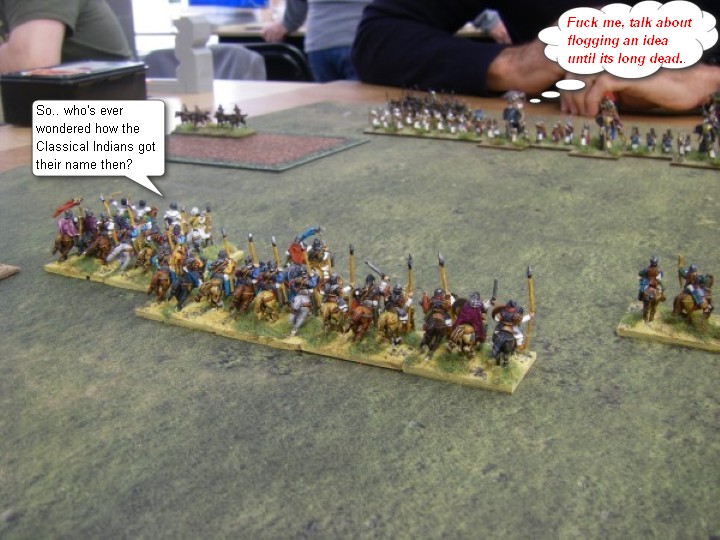
The better-rated cavalry in the Byzantine centre were a tad perplexed, unwilling to attack a line of elephants and archers yet also conscious that give these were the two main components in the opposing army that they would indeed need to attack them at some point if the game was ever to be decided.
On reflection, maybe biding their time and seeing if the Indians would advance and stretch themselves out into a thinner line might be the best idea for now ?

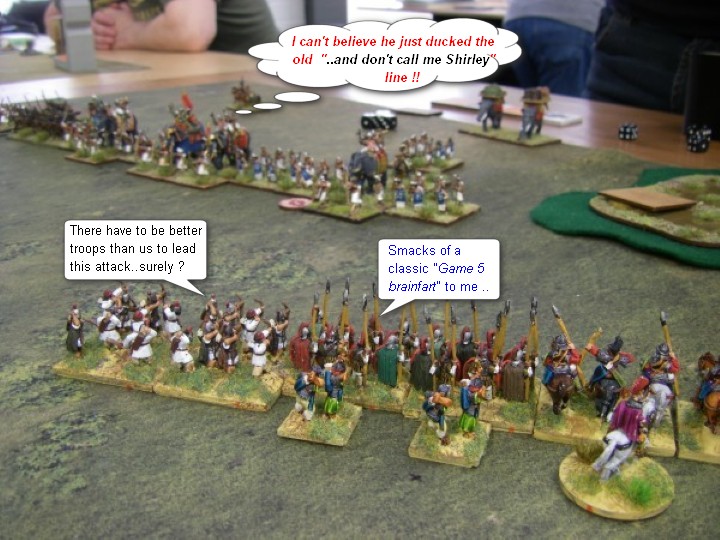
This wait and see approach left the Skoutatoi and their friendly archers with the weight of expectation pressing heavily upon them as they continued to inch forward
The left hand end of the Indian line did look tempting - but relying on Mediocre Spearmen to unpick a quadruple-victoriouos Indian army whilst the expensive and expansive elite cavalrymen of the Byzantine army stood and waited also smelled somewhat like the kind of plan which may not turn out to be scented with the rose petal aromas of success.
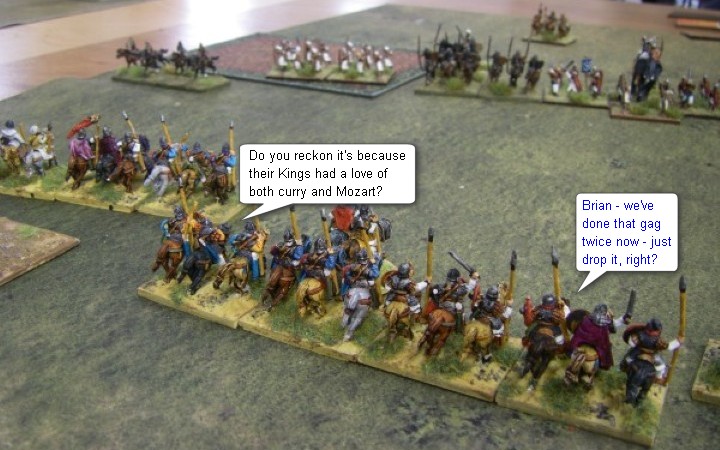
Finally, an opponent worthy of the Bucellarii! The Indian Almost-Rajput lancers could contain their enthusiasm no longer, and started to wriggle out from the line of elephants and archery to position themselves ready to launch some sort of attack.
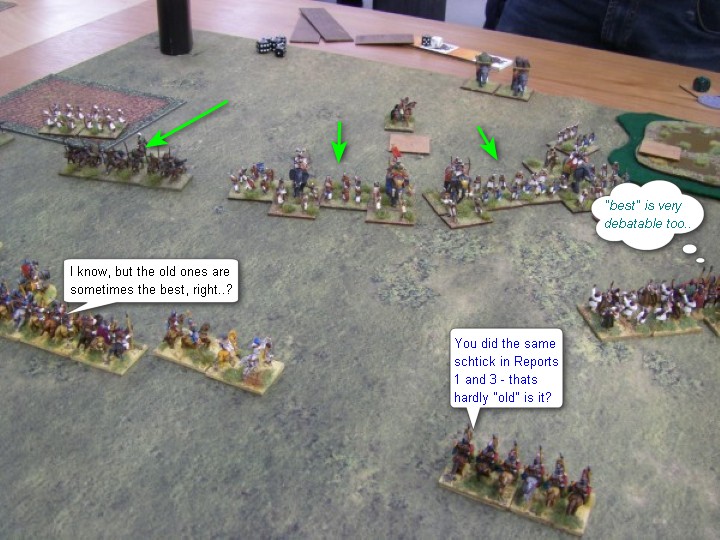
 The wait and see plan seemed to be working, as the Indians advanced in an ever-broadening arc to try and engage the various patient elements of the Justinian army.
The ancient Indian science of mathemtatics was now being applied to the question of whether only having 4 elephants would be the right thing to do. This simple binary choice seemed now to take on an especially crystal clear focus for the Indian archer/swordsman units, not all of whom had been handed a lottery ticket in life stamped with the phrase "You get to stand next to an elephant"

Suddenly battle was joined, as the Indian advance revealed enough un-elephant-infested front line surface to allow the Byzantine cavalry to decide now was the time to have a go (if they thought they were hard enough)
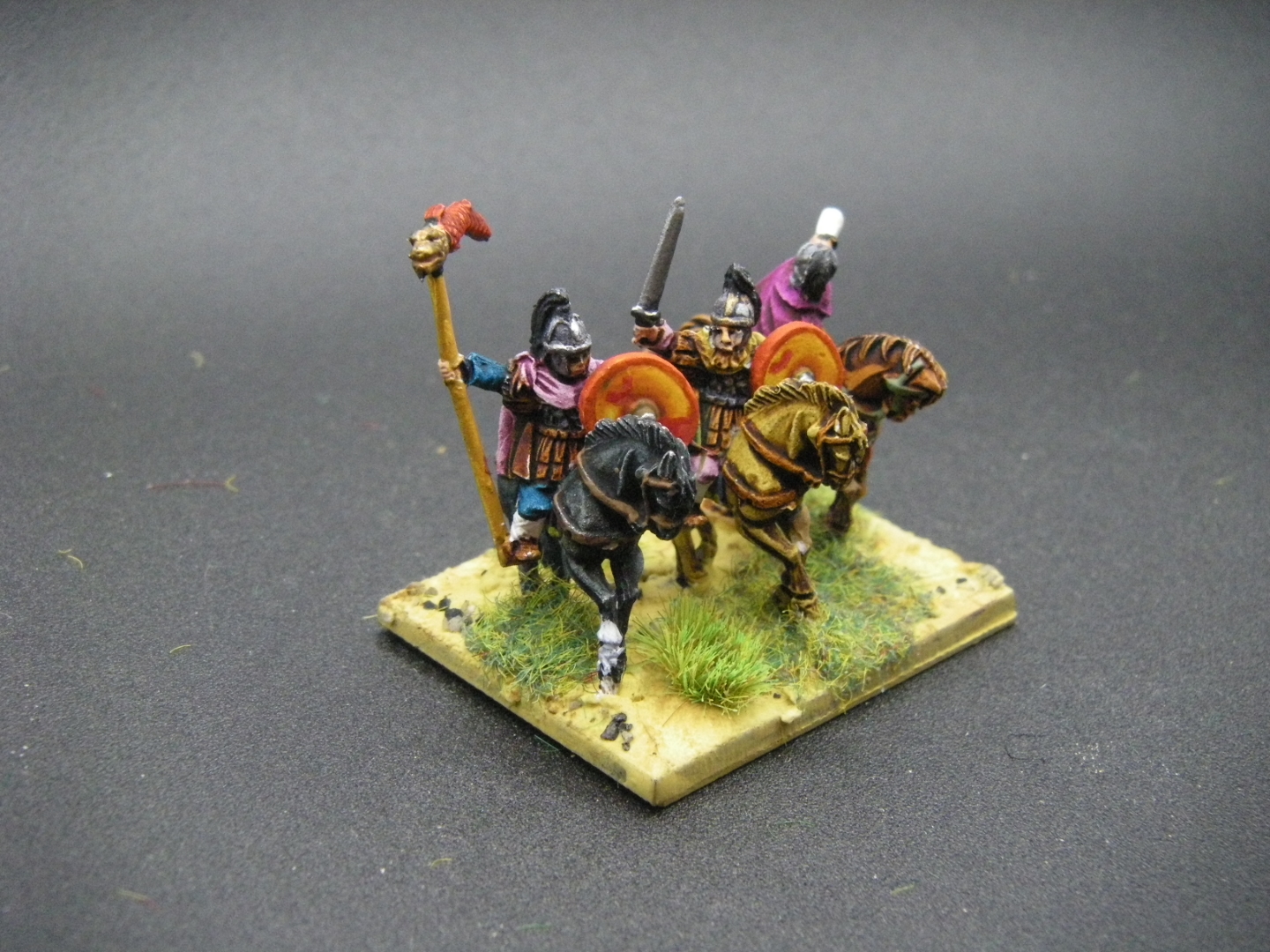
Technically the Indian cavalry facing them were also Elite Lancers, but the Byzantines were newer figures,more colourfully painted and had enjoyed a more varied and less spicy diet when they were growing up, so surely they would prevail in this clash of armoured quality cavalry ?
Little Known Facts About The Justinian Byzantines
Imperial recruitment officers in Thrace briefly attempted to improve enlistment numbers by promising new soldiers “rapid promotion opportunities and exciting foreign travel.” While technically accurate, complaints soon emerged from recruits who discovered the exciting travel destinations included plague-ridden Italy, the Syrian desert, and whatever frozen nightmare lay north of the Danube.
One surviving veteran sarcastically described the Byzantine military career path as “three years marching, two years starving, and one glorious afternoon being trampled by Ostrogothic cavalry.”
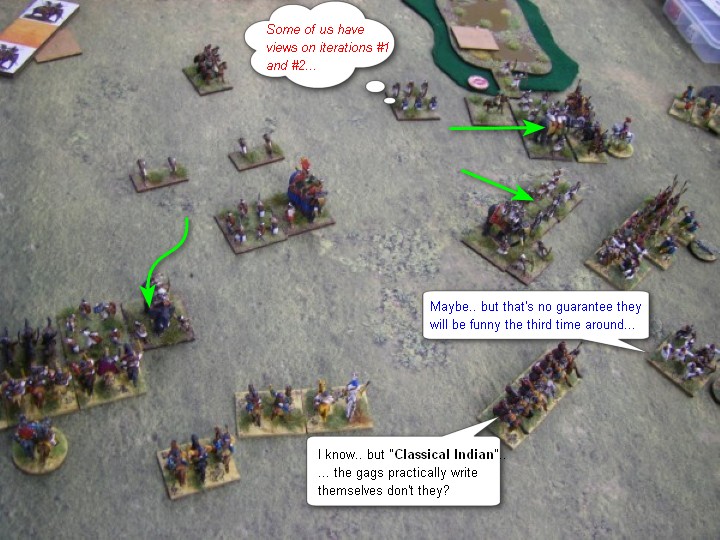
The advancing Indians were now very widely spread, leaving a series of frustratingly "not quite big enough to sneak through" gaps in their line which teased and tempted Arab mercenaries and fully employed Byzantine line cavalrymen alike in equal measure.
In a blur of motion the Byzantines suddenly went for it and lunged forwards.
The Indians were starting to shift their elephants left and right, seeking to get the mighty beasts involved in the smattering of combats that had already broken out across the table, and the Byzantines realised that they had to pin the pachyderms down and risk evading from their inevitable charges if they were to halt the grey tide.

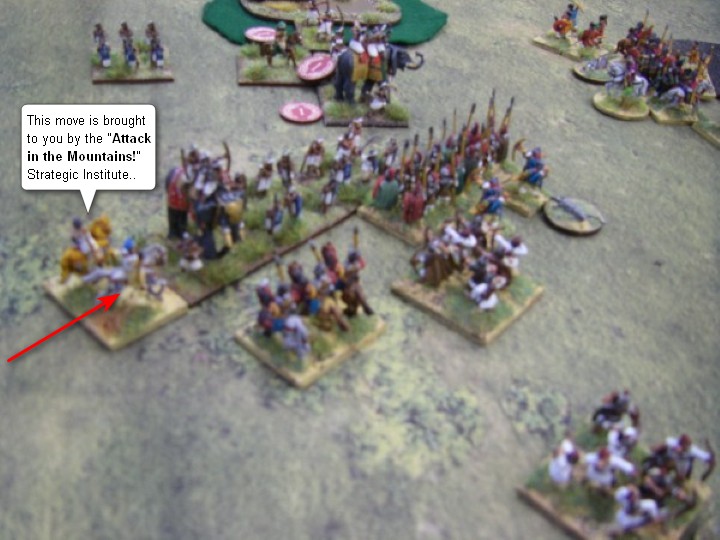
Everything and anything was on the table when it came to trying to stop the advance of the elephants - although for these Arab Light Cavalry javelinmen, charging one of the massive animals in the flank simply to try and turn it away from some far better and more well paid Bucellarii did seem like a big ask from their erstwhile paymasters.
Little Known Facts About The Justinian Byzantines
Byzantine siege engineers allegedly became fascinated with the idea of psychological warfare after hearing rumours of Chinese fireworks. Lacking the necessary technology, they instead launched flaming geese over enemy walls at night while trumpeters shouted exaggerated casualty reports in several different languages.
The tactic achieved mixed success. One Gothic garrison surrendered immediately, while another simply cooked the geese and sent back a polite note thanking the Byzantines for the unexpected dinner.
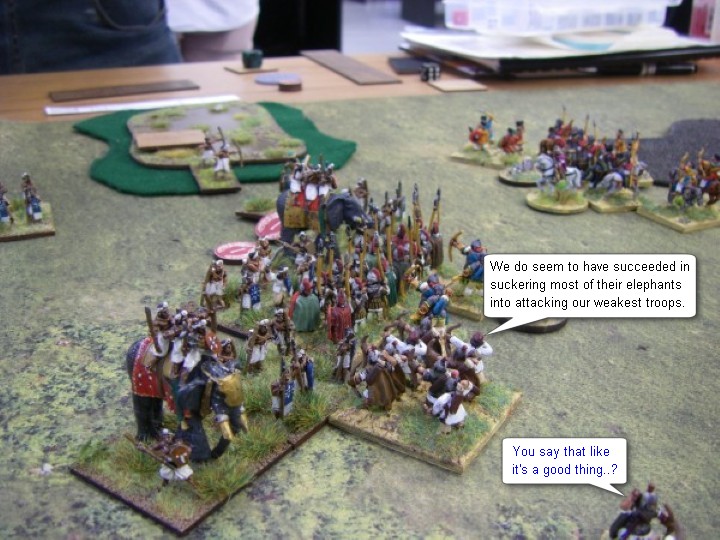
And so it proved, with the Arabian horsemen destroyed instantly, not even requiring the Indian beastmasters to turn their mounts to face them.
With proper Byzantine cavalry reeling under sustained archery and evading from the repeated elephantine charges, the inherent unfairness of life as a garrison Skoutatoi was coming into sharp relief, as suddenly everyone noticed that the crappest troops in the whole Justinian army seemed to also be the only ones actually doing any fighting!

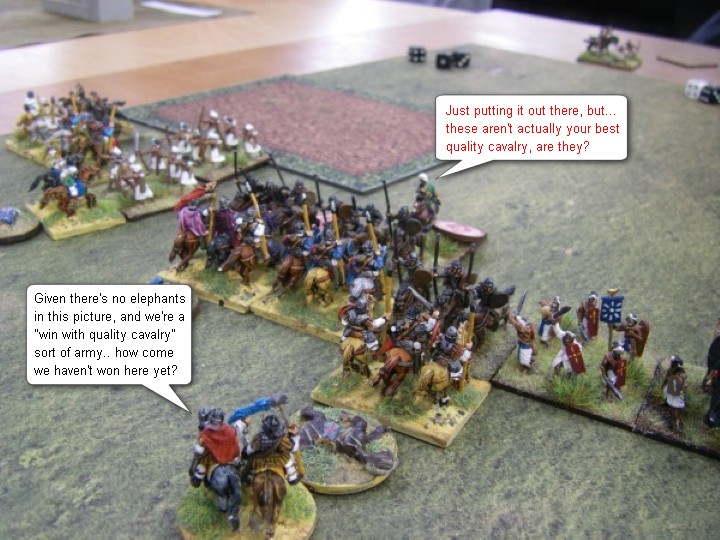
Elsewhere Indian noble lancers were locked in a deadly wresting match with Byzantiums cutting edge cavalry units - and unfortunately for the Asio-Europeans the people of the Indies were proving to have the edge on this sunny afternoon on the South Coast.
Indian Cavalry Regiments.. Today!
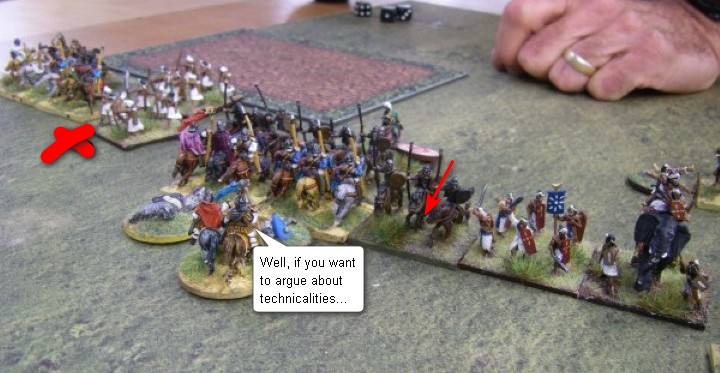
The morale of the Byzantines suddenly crumbled, and some of the finest and best trained horsemen in the long history of the Roman peoples turned, fled and were trampled underfoot in a decidedly non Led Zeppelinesque fashion.
Justinian had committed everything to winning this battle, but instead his troops were now looking like nailed on losers
This was supposed to be the moment and the location to unzip and outflank the entire Indian army - not the genesis point for a crushing disaster!
Little Known Facts About The Justinian Byzantines
Court gossip in Constantinople claimed that Belisarius maintained a secret corps of scouts trained to blend into barbarian taverns by pretending to enjoy terrible poetry and watered-down beer. Their disguises were reportedly so convincing that several agents accidentally became genuinely popular among the Goths.
One spy’s cover was ruined after he drunkenly attempted to explain Roman tax law to a group of Franks, an act so suspicious and unnatural that he was immediately identified as an imperial official.

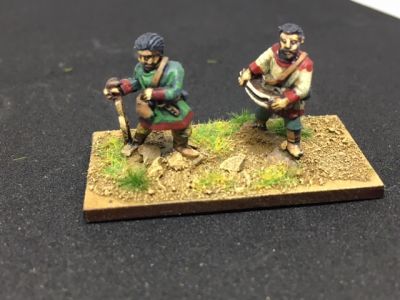 The Skoutatoi were not going to outperform in two battles in a row - they too lost heart and picked up hit markers in ever more garish colours as their losses steadily mounted
The Indian army was now hitting its big grey trunk-waving stride, and that stride was stomping itself onto Byzantines everywhere you looked.
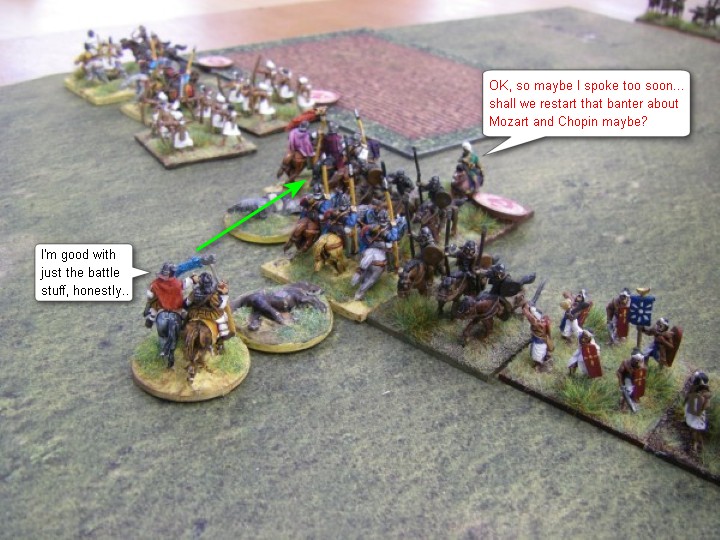
Desparate to salvage some pride, the Bucellarii girded their loins and fought bravely back against the seemingly inexorable Indian lancers, rocking them on their heels even as the melee descended into a swirling mass of erratically random combat.
Utter disaster might potentially be averted, but even so it was increasingly hard to see what the Byzantines might be able to achieve beyond some face-saving recovery casualties, as the rest of the Indian army had by now pressed on far past this zone of horse-on-horse action.
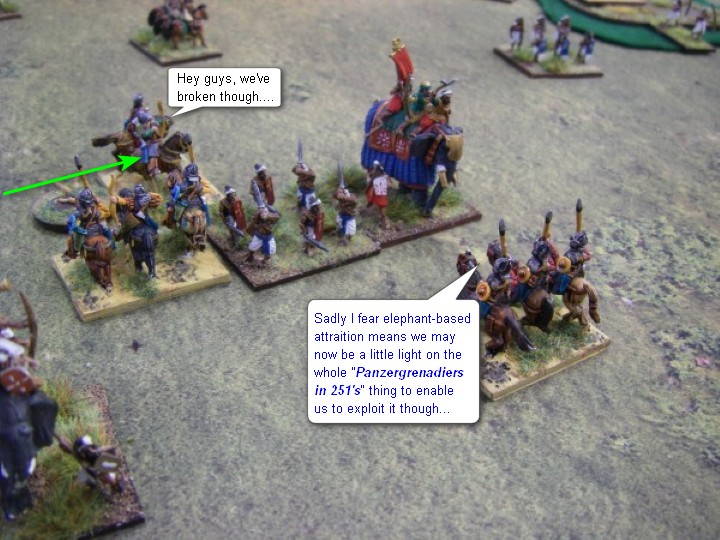
As the table opened up even more, the opportunities the Byzantines had hoped would fall into their laps did finally begin to crawl blinking from the swamp of elephant and archery based doom.
But, even where gaps could be filled with Justinian cavalry, each potential opponent seemed attached to an elephant, and those elephants were not looking to throw in any sort of towel anytime soon

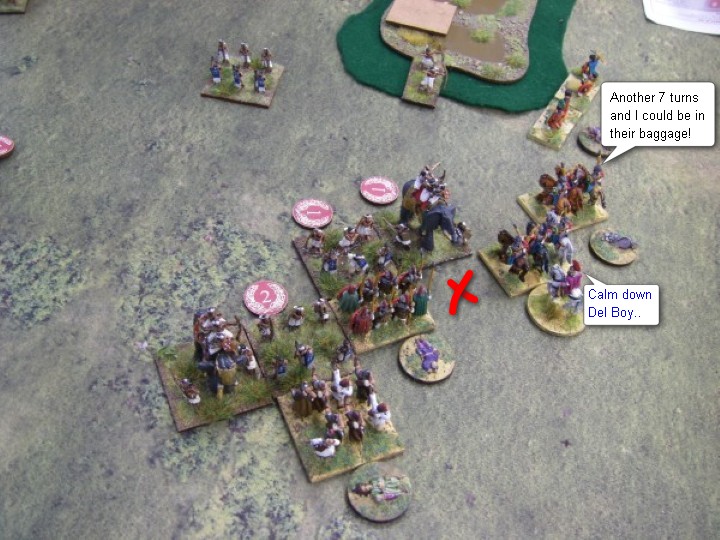
With half of the Skoutatoi now gone, the real end game hove into view as the Byzantines were pretty much forced to commit actual honest to goodness archers into melee to try and shore up an already nearly collapsed line.
Little Known Facts About The Justinian Byzantines
In an effort to modernise battlefield communications, Justinian supposedly approved the use of brightly coloured signal flags intended to coordinate cavalry manoeuvres across long distances. Unfortunately, many officers interpreted the signals differently, resulting in several battles where units enthusiastically charged in completely opposite directions.
A surviving operations manual attempted to clarify matters by stating that a yellow flag meant “advance cautiously,” except on feast days, during rainstorms, or when facing Huns, in which case it apparently meant “retreat immediately and blame the infantry.”
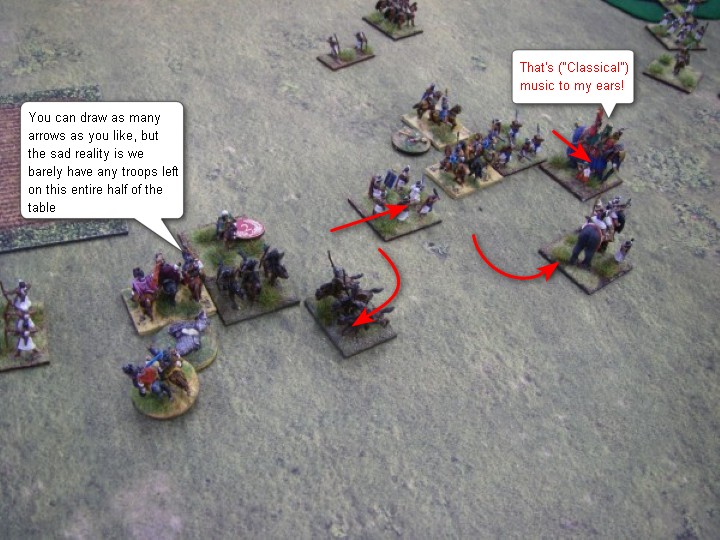
As the camera panned out it revealed a scene of failed strategy, with the huge gaps that had opened up in the ever-advancing Indian line occupied by nothing at all, other than the elephant-crushed remains of Byzantine cavalry and Skoutatoi. Defeat was now very close indeed.
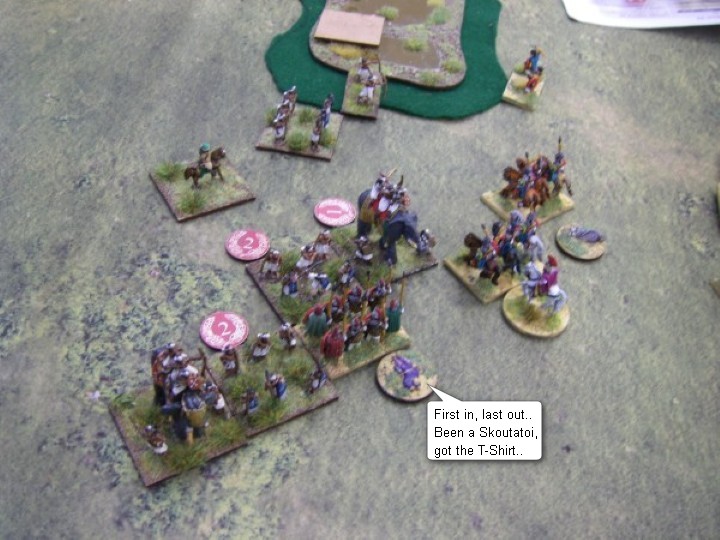
And, with the archers who should never really have been needed collapsing like a section of the Theodosian walls built by a cowboy builder using materials kindly supplied to him at a surprising discount by the Ottoman Sultan of Turkey's own building supplies company, the Byzantines collapsed to defeat against the entirely victorious 5/5 Indians!
Read on for the post match summaries from the Generals involved, as well as another episode of legendary expert analysis from Hannibal
Post Match Summary from Justinian Bieber, the Byzantine Commander
 Citizens of the Eternal Empire, before the whining historians and professional pessimists begin scribbling their little accusations onto parchment, let us calmly examine what truly occurred upon the Indian frontier. Firstly — and I stress this with immense dignity — the Indians possessed elephants. Actual elephants. Gigantic armoured mountain-beasts with tusks, towers, banners, and apparently an unlimited capacity to terrify horses. Frankly, there are serious philosophical questions as to whether deploying creatures the size of apartment buildings even constitutes fair warfare. Rome was built upon discipline, engineering, and heavy taxation, not upon attaching bells to enormous wildlife and sending it lumbering toward respectable Christians.”
“Nevertheless, did I retreat? Did Justinian Bieber tremble? Never. I devised a strategy so sophisticated that lesser minds are still struggling to comprehend it. I observed that the enemy had deployed securely between rough terrain, believing themselves untouchable. Most commanders would have launched a foolish frontal assault directly into the elephants and died stupidly beneath twelve tonnes of angry herbivore. But not I. No — I lured the Indians forward. I tempted them from their safe ground with da5ling manoeuvres and irresistible tactical bait. The enemy believed they were advancing under their own initiative, when in reality they were dancing precisely to the rhythm of my brilliance. One might even say they were compelled to ‘Love Yourself.’”
“And for a glorious moment, the plan worked perfectly. Our magnificent Byzantine cavalry identified a vulnerable section of the enemy line entirely lacking elephants — a miracle almost biblical in nature. My riders charged with incomparable courage, smashing through the gap exactly as intended. The Indian infantry wavered. Their banners faltered. Victory itself stood before us, radiant and inevitable, practically composing triumphal hymns in my honour. At this point I was already considering the placement of new statues. Some would say this was premature. I say it demonstrated healthy confidence.”
“But then occurred the truly unreasonable part of the battle. The Indians, displaying a frankly unsporting level of competence, committed their noble lance-armed cavalry into the breach. Now, I had naturally assumed these aristocratic riders would behave as most nobles do — pose magnificently, issue dramatic speeches, and then collapse at the first sign of danger. Instead, they charged directly into our exhausted cavalry with extraordinary aggression. Their lancers fought fiercely, skilfully, and — I hesitate to admit — rather effectively. Our horsemen, already fatigued from the breakthrough and the oppressive heat, found themselves suddenly overwhelmed. The gap we had created became clogged with confusion, dead horses, and officers desperately pretending things were still going according to plan.”
“From that single reversal, defeat spread across the battlefield like gossip through the imperial court. One flank recoiled, another panicked, and before long entire formations were retreating with the sort of enthusiasm usually reserved for tax collectors fleeing riots. Yet I ask you this: is that truly the fault of the Emperor? Am I personally responsible for the climate? For elephants? For the stubborn refusal of Indian cavalry to behave according to my expectations? At some point responsibility must also rest with geography, zoology, and fate itself.”
“I have, of course, considered whether Rome itself should adopt war elephants. Certain advisors suggest converting portions of the imperial stables accordingly. Empress Hailey has already objected on the grounds that elephants would ruin the palace gardens and ‘smell weird near the fountains,’ which is admittedly a compelling strategic concern. Furthermore, there are logistical questions. How many oats does one feed a beast the size of a cathedral? Can elephants be taught proper Roman etiquette? Would they salute during parades? These are matters requiring careful study, not reckless innovation.”
“So let no man say Justinian Bieber has been defeated by mere Indians. No — I was temporarily inconvenienced by improbable cavalry heroics, unethical elephant usage, and conditions fundamentally hostile to artistic genius. Rome remains mighty. Rome remains glorious. And above all, Rome remains under the guidance of a ruler who refuses to apologise simply because everything went catastrophically wrong. For as I told my generals after the battle: ‘Sorry’ is a song title, not an admission of guilt.”
Hannibal's Post Match Analysis
 “And now we arrive at the Indian campaign — a catastrophe made all the more embarrassing because the enemy army behaved with the subtlety of a drunken actor shouting stage directions. Truly, defeating the Indians ought scarcely to qualify as military accomplishment at all. Their methods are so predictable that young recruits are practically taught the solution before they are trusted with sharpened spears. ‘Observe the elephants. Draw them forward. Stretch the line. Strike where the beasts are absent.’ There. Congratulations. You are now tactically qualified to command at least half of Asia.”
“And to give the devil his due, Justinian Bieber initially did exactly this. He teased the Indians from their comfortable position between the terrain with admirable patience. He manoeuvred carefully, baited their advance, and induced them to extend themselves. For a moment — one fleeting, miraculous moment — I thought perhaps the perfumed songbird had finally learned restraint. The Indians waddled forward precisely as expected, their elephants lumbering into exposed positions, their line elongating like wet laundry stretched across a courtyard. The trap was set beautifully.”
“And then, because the gods cannot permit comedy to die, Bieber ruined everything by attacking too early.”
“Too early! Before the Indians were fully exposed. Before their cohesion had properly unravelled. Before their reserves had drifted sufficiently far apart. Having done the difficult work with admirable discipline, he suddenly abandoned discipline altogether and hurled his forces forward with the impatience of a child opening presents before the festival begins. One almost hears the officers desperately shouting: ‘Wait! WAIT!’ while Justinian gallops off convinced destiny itself cannot endure another five minutes without witnessing his magnificence.”
“And then we come to the Skoutatoi. Oh merciful Baal, the Skoutatoi. Again. Again! At this point one suspects Bieber actively dislikes these men. He placed the only infantry in his army fundamentally incapable of skirmishing and retreating gracefully directly at the front of an engagement dominated by missile troops, cavalry manoeuvre, and elephants. Brilliant. Inspired. Perhaps next he shall deploy siege engineers as cavalry scouts or use librarians to repel horse archers.”
“The entire Byzantine tactical system depended upon flexibility — screening, withdrawing, harassing, reshaping lines under pressure. Yet the Skoutatoi, being essentially solid defensive infantry, possess all the nimble evasiveness of marble statues. And Bieber, tactical visionary of our age, decides these are precisely the troops best suited to absorbing the initial chaos of an Indian assault. It is the military equivalent of leading a hunting party with the slowest mule.”
“But even then the disaster might still have been salvaged had Bieber not committed his cavalry under the astonishing assumption they would simply overpower the Indian nobles. Why? On what basis? The cavalry were near-identical in equipment, quality, and role. Armoured lancers striking armoured lancers. There was no magical Byzantine superiority here beyond the Emperor’s limitless confidence in his own legend. Except the Indians possessed two advantages so obvious they may as well have been written upon the sky in flaming letters.”
“Firstly: more bowmen. Vastly more. Indian archers softened and disrupted the Byzantine horse throughout the engagement while Bieber apparently regarded incoming arrows as a minor atmospheric inconvenience. Secondly — and here we arrive at my personal favourite — elephants. Magnificent glorious elephants! Towering engines of panic and disruption! Creatures specifically designed by nature to make cavalry reconsider their career choices. Hannibal himself employed elephants because unlike Justinian Bieber, I recognise the military value of inducing existential terror in both enemy horses and enemy commanders simultaneously.”
“So what occurred? The exhausted Byzantine cavalry burst into the gap, initially succeeding through momentum alone, only to collide with fresh Indian nobles supported by archery and elephant pressure. The breakthrough stalled. Confusion spread. Horses recoiled. Lances shattered. Suddenly the carefully engineered victory inverted itself entirely, like a stage actor falling through scenery after delivering the first half of a triumphant speech.”
“And thus ended a campaign that had promised much. Two defeats — against the Indians and against the rival Byzantines — both born from precisely the same flaw: Justinian Bieber’s fatal belief that recognising the enemy’s plan automatically guarantees defeating it. He understood what both opponents intended. Everyone understood what they intended. Their strategies were as obvious as a peacock in a monastery. But recognising danger is not the same as managing it. A cook may recognise fire perfectly well and still burn down the kitchen.”
“The Indians would advance ponderously behind elephants and support their cavalry with missiles. Of course they would. The rival Byzantines would concentrate force against exposed positions. Naturally. These plans possessed all the mystery of tax collection. Yet Bieber still contrived to underestimate both opponents through sheer overconfidence. He sees predictability and mistakes it for weakness.”
“And that, ultimately, is the tragedy of Justinian Bieber as a commander. He possesses intelligence, imagination, and genuine tactical instinct. But he forever mistakes the first successful movement of a battle for the conclusion of it. He falls in love with his own plans halfway through executing them. Like his musical performances, his campaigns begin with extravagant confidence and impressive staging… only to collapse awkwardly once sustained discipline becomes necessary.”
That's the end - so why not go back to the Match Reports Index and read some more reports?
Or...add your comments on these reports on the following forums
You may also like....
Game 1 Justinian Byzantine vs Zapotec
Game 2 Justinian Byzantine vs Justinian Byzantine
Game 3 Justinian Byzantine vs Thematic Byzantine